
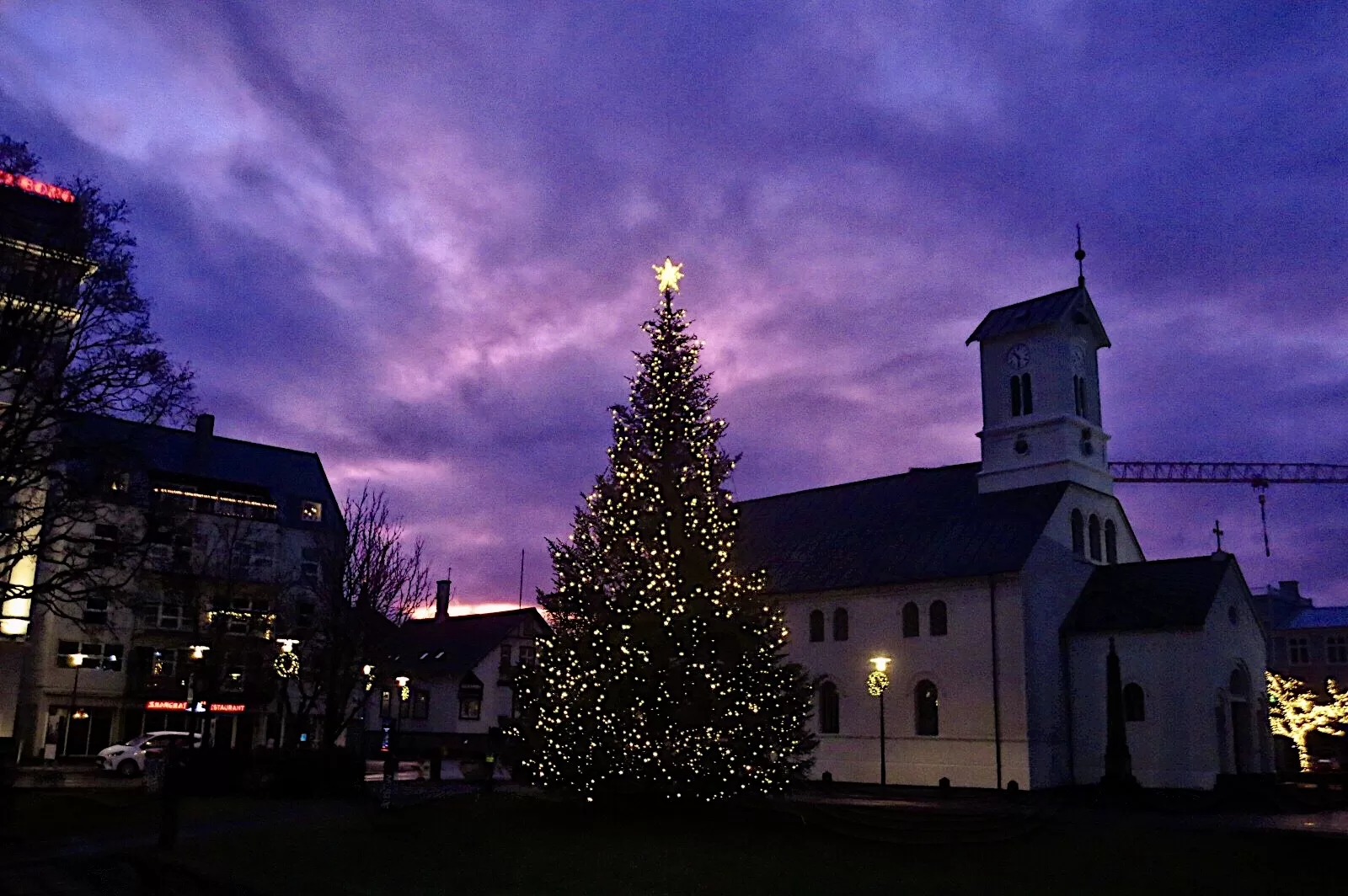
Christmas & New Year’s Traditions
Christmas trees with lights are ubiquitous in Iceland during the Christmas season. Residences, cafes, stores, and offices all carry them! Trees are decorated with ornaments only on Christmas Eve, and traditionally, it is a family event with parents, children, and family members decorating the tree together. Historically, Christmas trees would not appear in Icelandic homes until Dec. 23rd. Yet all around Reykjavik, select trees in public spaces are covered with lights throughout the wintertime. These “trees of light” help brighten up the long winter days, with the sun not rising until close to 11 a.m. and setting at 4 p.m.!
The bonfire tradition is the highlight of Icelandic New Year’s Eve. Icelanders will meet friends and family for dinner, then gather at the local bonfire around 8 or 9 pm. These bonfires, found in open areas around Reykjavik and Iceland, can be up to 10 feet high. Music and fireworks often complement the bonfire gatherings.
The real firework extravaganza takes place at the stroke of midnight. Popular places to see the New Year’s fireworks in Reykjavik include Hallgrimskirkja, the main Lutheran church, Perlan, a museum and glass dome on top of a hill, the Sun Voyager sculpture by the waterfront, Tjörnin, the city pond, and Harpa, the concert hall. However, 2021 marked the second year in a row that Covid protocols canceled Reykjavik’s firework shows.
Many Icelanders watch Áramótaskaupið (the New Year’s Lampoon) on New Year’s Eve, a popular hour-long TV program recapping the year in a satirical, comic manner. Starting at 10 p.m., the program covers everything from politics to culture to news and features big opening and closing musical numbers. Like the Super Bowl, families and friends curl up to watch the program together and debate issues afterward; the advertisement slots are also the most expensive on Icelandic television.
Held jointly with the Christmas market every December, the Nova skating rink at Ingolfstorg Square in central Reykjavik is famous among Icelandic families. While skating is not too widespread in Iceland, Nova is beneficial for getting into the Christmas spirit, considering its location adjacent to the Christmas market alley. The rink gets busy in December, especially on Fridays and Saturdays; however, only 15 people are allowed on the rink at a time now due to Covid restrictions. Stands nearby sell hot chocolate, Irish coffee, and refreshments, including waffles, typically served with whipped cream and jelly.
Heiðmörk Christmas Market, nestled in the woods on the outskirts of Reykjavik, is open on weekends during the Advent season. The market showcases a variety of handicrafts and delicacies, and many locals buy their Christmas trees here, which are grown in Iceland. Parents take their children to the story hour in the forest, where they gather around a campfire listening to Christmas tales. A cup of hot chocolate or cappuccino from Heiðmörk’s café is welcome in the cold weather!
A festive Christmas Eve tradition in Iceland is Jólabókaflóð, or Yule Book Flood, in which books are exchanged as gifts among loved ones. Iceland is a literary nation that has historically produced many writers and chroniclers. To this day, Icelanders remain passionate about reading and writing; in fact, every one in ten is a published author. Every year, towards the end of November, a catalog listing the latest books in Iceland – bókatíðindi – is mailed to every home. The book-giving tradition is such an integral part of Icelandic culture that locals believe the holiday season does not officially start without bókatíðindi. After all the presents are opened on Christmas Eve, family members spend the rest of the evening reading their new books over hot chocolate. Without a doubt, the world can adopt this charming tradition!
Many windows in Icelandic homes throughout December are decorated with triangular candle structures resembling a menorah. While the idea appears to be uniquely Icelandic, it was introduced in the 1960s by an Icelander who went to Sweden on business. He noticed the candle structure in the windows and brought back two for his old aunts in Iceland. Soon, everyone decided they had to have one, and the trend caught on like wildfire!
Christmas Cuisine
Whereas Christmas officially starts for much of the Christian world at midnight on Christmas Eve, in Iceland, it begins with the ringing of church bells at 6 p.m. on Christmas Eve or aðfangadagur. It is the primary day of celebrations where family members decorate the tree, open presents, and have dinner.
Popular Christmas dinner choices include Hamborgarhryggur (smoked rack of pork) and smoked turkey, each with their special sauce and a selection of yellow or green beans or other vegetables, and hangikjöt (smoked lamb), which is served with a white potato sauce called uppstúfur. Langoustine (Icelandic lobster) and salmon are also common, with langoustine sometimes served in soup. Vegetarians can choose plant-based steaks.
Since the olden days, it has been customary to have smoked lamb for dinner on Dec. 23rd, the day of St. Thorlak (Iceland’s patron saint and only saint). However, a tradition from western Iceland also became commonplace – eating the fish called skate on the 23rd. To this day, families from the Westfjords have skate for Thorlaksmessa, the feast of St. Thorlak. Some may avoid skate because of its odor and high ammonia content, yet those from the western regions are accustomed to it. Skate is traditionally consumed with rye bread, potatoes, butter, and brennivín, the Icelandic schnapps, on St. Thorlak’s Day.
Another traditional Icelandic Christmas dish is rjúpa (ptarmigan, a small grouse), usually boiled and then fried and served with red cabbage, potatoes, and gravy. Legend has it that when the Virgin Mary summoned all the birds to cross a fire pit to prove their loyalty to her, the ptarmigan was the only bird that refused to do so. Therefore, it has feathers on its feet and was told it would be hunted. Nowadays, the ptarmigan is considered a protected bird in Iceland, and hunters are only allowed a certain number each year.
Although dinner choices vary over the winter holidays, the norm is to have smoked pork on Christmas Eve, smoked lamb on Christmas Day, and smoked turkey on New Year’s Eve.
Christmas Eve gatherings are usually among immediate families. On Christmas Day and New Year’s Eve, people celebrate with extended family members and friends.
Christmas meals are accompanied by Jólaöl (Christmas Ale) or Malt og Appelsín, a non-alcoholic beverage made of a blend of Appelsín (orange soda) and malt. Most families prefer to make it themselves, although stores also carry it premade.
Laufabrauð, or leaf bread, is a traditional Christmas bread originating from the northern parts of Iceland. Thin, round, and flour-based with a diameter of about 6 to 8 inches, laufabrauð is decorated with leaf-like geometric patterns and then deep-fried in hot fat or oil. It serves as a side dish to Christmas meals or is consumed with butter and a cup of hot chocolate for breakfast. Members of the household get together and make it throughout December, with children learning intricate bread patterns from their elders. Laufabrauð keeps for up to several weeks and is also sold in shops.
A popular Christmas dessert is Hrísgrjónagrautur: rice pudding served with cinnamon sugar, hot caramel syrup, or cherry sauce. According to tradition, the host places an almond in the pudding and fills the pudding in small bowls. The person who finds the almond in their bowl is the lucky one and gets a small gift!
Jólasveinar
Unlike most countries that celebrate the Christmas season with a single Santa Claus, Icelandic children are fortunate to have thirteen Jólasveinar, or Yule Lads, visiting them. Instead of stockings on fireplaces, Icelandic children leave shoes on their windowsills. On Christmas morning, they wake up to see small gifts that the Yule Lads have dropped in their shoes. Unless the child has been naughty, in which case they receive a potato!
According to legend, all the Yule Lads set off from their family home in the Highlands, traveling on foot over the mountains. One by one, they make their appearances over the thirteen nights before Christmas. Each of the Yule Lads has his idiosyncrasy and specific type of shenanigan.
Stekkjarstaur (Sheep Worrier): the first to arrive in town on Dec. 12, he gets his name from his habit of sneaking into the sheep pen. He aims to suck milk from the ewes, but he may have difficulty bending down, given his stiff legs. It is said his temperament is as stiff as his legs, and if he’s feeling particularly mischievous, he might scare or even steal a sheep or two!
Giljagaur (Gully Gawk): as his name implies, he would hide in the deep gullies and dark ravines, then sneak over to the stables. Secluding himself until the cows have all been milked or finding an opportune moment when the milkmaid is distracted, he would pounce upon the milk pail and steal the rich cream on top.
Stúfur (Stubby): the shortest of the pack. Given his short legs and Iceland’s high snowfall, trekking over the mountains takes him more time and effort than his brothers. He is known for stealing pans with crusts or leftover food on them. Children are advised to put out a stool or a shoebox for Stúfur to stand on if their shoe is on a high windowsill!
Þvörusleikir (Spoon Licker): this one’s brand of troublemaking involves hiding out in dark kitchens, waiting for wooden stirring spoons to be set aside so he can pounce upon them and lick up the morsels.
Pottasleikir (Pot Licker): Coming on the heels of his brother, who licked up all the spoons, this one is on the lookout for pots that have not yet been washed so he can steal the leftovers, licking the sides and bottoms.
Askasleikir (Bowl Licker): the last of the lickers, arriving on Dec. 17. His preference is for the askur, a lidded bowl commonly used in the olden times in turf houses. Each household member would have their own askur, which they used to keep food warm. Hiding under a bed, Askasleikir would wait until the bowls were set aside on the floor or the family was distracted, then snatch the bowls and lick them clean.
Hurðaskellir (Door Slammer): although not obsessed with scrounging food like most of his brethren, this one has a more bothersome habit – slamming doors. He takes delight in performing this act in the middle of the night and waking the whole household.
Skyrgámur (Skyr Gobbler): the eighth Yule Lad has an easier time scavenging his food of choice than his brothers, as there is almost always plenty of Skyr to be found in Icelandic households. Infamous for being a glutton, he will always stuff himself with more Skyr than his stomach can take!
Bjúgnakrækir (Sausage Swiper): in the olden days, bjúgu (large sausages) were hung in strings from rafters in Icelandic kitchens. Lurking in a corner until everyone leaves the kitchen, Bjúgnakrækir climbs stealthily up the rafters to swipe the sausages being smoked. However, in these days, bjúgu are more likely to be stored in refrigerators.
Gluggagægir (Window Peeper): probably the creepiest of the Yule Lads; he lingers around windows, on the lookout for knick-knacks around the house he can steal later when everyone has gone to bed. As he always leaves presents in shoes, he considers the pilfering a fair exchange!
Gáttaþefur (Doorway Sniffer): with his unusually long nose and highly developed sense of smell, this one sniffs his way into kitchens where sweet-smelling laufabrauð is being baked. He’ll lurk in the shadows beyond kitchen doorways and await the chance to seize any bread he can get his hands on.
Ketkrókur (Meat Hook): climbing up onto the roofs of old turf houses, the penultimate Yule Lad lowers a long pole with a hook down the chimney to snatch some smoked meat that might be hanging from the rafters. If he’s feeling particularly cheeky, he’ll reach further into the kitchen to grab a bite from a pot cooking on the hearth.
Kertasníkir (Candle Beggar): before the advent of electricity, candles were used to light up Icelandic homes. They were instrumental in brightening up the dark atmosphere during the wintertime. These candles were often made of edible animal fat, enticing Kertasníkir to follow children around to steal their candles. Candles still have a significant presence at Christmastime in Iceland, and many children will leave small candles in their shoes on Dec. 24 for the Candle Beggar.
Jólasveinar, a uniquely Icelandic part of folklore, does not exist in other cultures. With their rough farm clothes, various beard shapes and sizes, and mischievous tendencies, the Yule Lads have managed to ward off the foreign influence of a chubby and jovial Santa Claus.
In the thirteen days leading to Christmas in 2021, thirteen buildings in Reykjavik adopted their own Yule Lad, displaying their 3-D animated image on the wall and depicting each acting out their special shenanigan.
Community Life
Because of its small population of under 370,000 people, Icelandic culture is very communal – an ingrained sense of trust roots itself in people’s mindsets. Iceland has been named the safest country in the world for 13 consecutive years, something Icelanders take pride in.
A popular communal activity in Iceland is soaking in thermal bathing pools. With abundant geothermal heat, numerous outdoor facilities, both private and public, are available. Reykjavik alone has seven public thermal bathing pools. Sundhöllin, the oldest pool in Reykjavik, which is located a short distance from Hallgrimskirkja, has an indoor and outdoor pool, three hot tubs, a cold tub, and two saunas. Taking a dip before or after work with friends or family is a daily routine for many locals.
If you come across what looks like an abandoned carriage on the sidewalk during a stroll in Reykjavík, don’t panic! Parents leaving babies in strollers outside their houses or cafes is customary in the Nordic region. Icelanders believe their children take longer and better naps when they sleep outdoors, which is also beneficial for children’s immune systems. With Iceland being as safe as it is, people feel secure enough to leave their babies outside.
Reykjavik is a colorful city to explore, and one cannot help but notice the fantastic street art dotted throughout. As blank walls tend to be covered with graffiti sooner or later, the municipality commissions talented young artists to create art in designated areas around town. The graffiti taggers respect this and will not come and deface the art. If any graffiti exists around town, it is never gang-related.
The rainbow walk leading to Hallgrimskirkja was first painted in 2015 as a sign of support for diversity and acceptance. It has been repainted annually since then and remains one of Reykjavik’s most picturesque, Instagram-worthy locations. Iceland is among the most LGBTQ-friendly places in the world.
Feminism also runs deep in Iceland. As citizens of the first European country to elect a female president and the first country in the world with a political party entirely formed and led by women, it is not surprising that women quite literally run their world in Iceland!
All Icelandic citizens are entitled to universal healthcare and jobs within the Nordic Union – Denmark, Norway, Sweden, and Finland. Therefore, these countries are popular destinations for Icelanders to pursue master’s or doctoral degrees and job opportunities. Many who study or work abroad return home to start families.
“Pardon my Icelandic,” Netflix’s first Icelandic comedy show, features Ari Eldjarn, Iceland’s famous stand-up comedian. In this hour-long special, Eldjarn focuses on the quirks of Icelandic culture and pokes fun at Nordic rivalries and linguistic differences. He has also appeared on BBC radio, Iceland’s national television, and Áramótaskaupið, the Icelandic New Year sketch show.
With Iceland’s spectacular natural scenery, rich culture, and unique lifestyle, tourism has surged in recent years. Iceland welcomed a record-breaking 2.3 million visitors in 2018 – more than six times its population.
CityWalk Reykjavik is a group of outgoing young locals who conduct two-hour walks of Reykjavik. Tours start in front of the parliament building. Guides convey unique local insights into their city and culture and take delight in introducing their hometown to visitors. They are generally optimistic about the tourist boom, as Iceland has tried to enhance tourism for years. It took a while for Iceland to become the popular destination it is today.
If locals tend to be skeptical about tourism, it is not because of the tourists themselves, but because of the importance of preserving the country’s natural areas and protecting certain areas from being overrun. For the most part, they are quite proud that people from all over the world travel to Iceland in the winter despite four hours of daylight.
The long, dark, cold winter months in Iceland have historically fostered an abundance of creativity. Hearing noises outside, seeing things in the dark, and having no electricity created fodder for folk tales in the old days, including stories about the Yule Lads. Icelanders have had to be resilient and resourceful throughout the centuries, surviving in harsh conditions and limited means. This resourcefulness is evident in their traditional housing, cuisine, clothing, and lifestyle.
The Icelandic language is one of the oldest languages in Europe. Iceland’s isolated location has led to minimal changes in the language over the centuries, and many Icelanders are mindful that Icelandic remains true to its original form. Children learn English and Danish at school from age six, alongside speaking their native language.
Iceland is the last country in Europe to have been settled. In 871, when the first Viking Age explorers from Norway arrived in Iceland, they found an uninhabited land with no indigenous or native people. Ingolfur Arnarson, exiled from Norway due to a crime, was the first to settle in Iceland. Throwing two carved pillars overboard, he built his settlement where they washed up and named the place Reykjavik, meaning Smoke Cove, due to the billowing fog rising from the area. There were around 15,000 settlers in total.
Unlike in other European countries, there were no vast waves of immigration in Iceland. Today, many Icelanders are descended from the first 15,000 settlers from Norway and, therefore, are distant or close relatives. An online database, Islendingabok, or “Book of Icelanders,” allows them to trace their family tree down to the settlement age. It is rare for a country to have these many details about its citizens’ genealogies!
Multicultural Reykjavik
Iceland is known for its positive outlook on cultural diversity. It ranks among the top European countries in holding progressive views on immigration and multiculturalism.
One of the ways Iceland has gained a multicultural ambiance is through food and dining options. In recent years, Reykjavik has emerged as a foodie destination, and its culinary scene features a diversity of eateries, including Thai, Vietnamese, Chinese, Greek, Middle Eastern, Italian, Indian, French, and Mexican restaurants. Icelandic restaurants enjoy popularity among tourists, especially those that offer modern twists on traditional dishes.
Reykjavik also boasts a thriving Latin dance scene. The Kofinn Bar and Bistro (on the corner of the famed Rainbow Walk) and Sólon Bistro (located in the city center) regularly host dance events and workshops. Salsa Iceland, Reykjavik’s premier Latin dance school on Laugavegur Street, offers dance courses and workshops year-round. In 2017, the Hilton Reykjavik Nordica hosted Midnight Sun Salsa, Iceland’s first salsa/bachata festival. Most dance events feature a blend of Icelandic and international dancers. As with arts and entertainment events everywhere post-COVID, the protocols in place have affected the usual vibrancy of Reykjavik’s dance scene.
The University of Iceland, the nation’s leading university, offers classes in both English and Icelandic and admits international and exchange students to some of its academic programs. Scholarships are available for students interested in learning Icelandic. “International Days” are also held at the university, which provides international students the opportunity to showcase their countries and traditions, allows Icelanders to learn about new cultures, and enables local and international students to get to know each other.
When the new British ambassador visited Iceland in 2021, the British embassy organized a meet-and-greet in Reykjavik, inviting all the Brits in town.
Hvunndagshetjur, a 2021 film by Magnea Björk Valdimarsdóttir, focuses on the experiences of foreign women in Iceland. The film was shown at Háskólabió, Reykjavik’s cinema and cultural center, from Dec. 6 to 9, and aired on Iceland’s national broadcasting service after Christmas. Valdimarsdóttir’s goal was to raise awareness of the challenges foreigners face in Iceland and their woven diversity into the Icelandic fabric.
Following mass immigration in recent years, Poles constitute the largest minority group in Iceland. Many are motivated to pursue job opportunities, with some planning to work in Iceland for a certain period, earn some money, and then return home for good, while others find they like it enough to end up staying permanently; they manage to take a loan from the bank and buy a home, learn the language fluently, and assimilate into the culture. Still, others find it hard to live in Iceland full-time or leave Iceland for good. They choose to live part-time in Iceland and part-time in Poland, earning higher wages in Iceland and traveling back to Poland often to visit their loved ones.
While Iceland is becoming more multicultural, its immigration story is relatively recent. With its small size and population – Reykjavik’s population is smaller than that of entire immigrant communities in larger cities – Iceland does not sustain the immigrant experience seen in other nations. The Polish population is the largest minority group, yet a Polish quarter typical of immigrant areas in bigger cities is nonexistent. Given the relatively small number of immigrant communities, some newcomers to Iceland face challenges because they do not fully belong to Icelandic society, nor do they have an immigrant community to join.
Iceland’s Polish groups have several Facebook pages, including Polish Events Reykjavik, Islandzki mój powszedni (Icelandic language instruction for Poles), and Prawnikislandia Prawnik. Members can post about their experiences, including negative ones, to warn others, such as when companies underpay or withhold salaries from their employees.
Poles in Iceland celebrate their country’s Independence Day on November 11 by participating in the Polish Independence Run, a marathon in Reykjavik sponsored by the Polish embassy and other Polish associations in the country.
Iceland has emerged as an unexpected Nordic asylum for Syrian refugees since 2015. Reykjavik’s police station, the Red Cross, and other municipalities work with the national government to assist refugees settling in the country. One Syrian family, whose daughter was born in Iceland after being granted asylum, gave their daughter an Icelandic name in honor of their new home!