
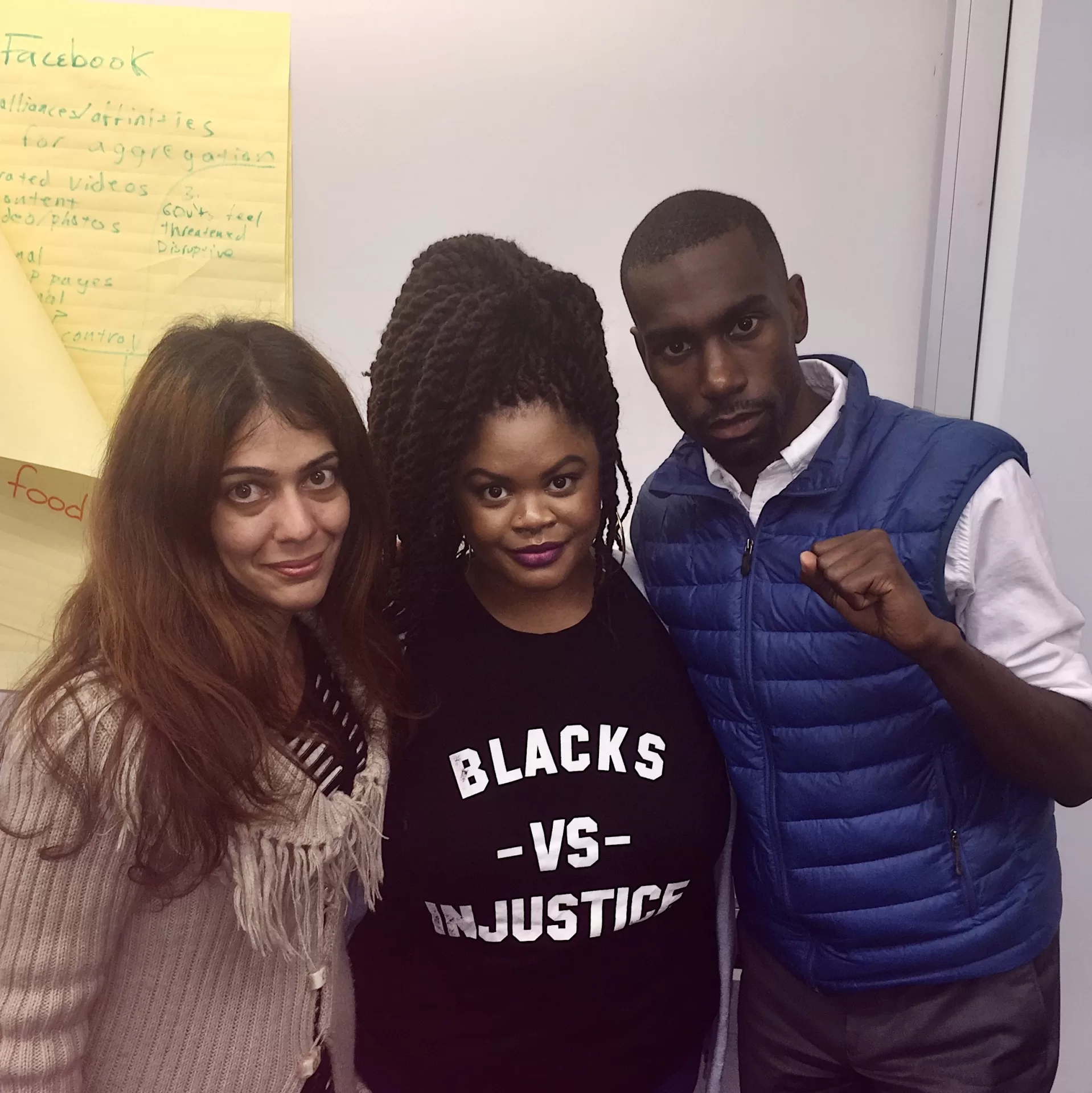
Dear DeRay,
I would like to express my gratitude for your visit to Yale Divinity School and discussion of the Black Lives Matter movement. It was truly inspirational and thought-provoking, and for me, a rare and unique experience to be in the presence of an activist for a day. You inspire me to become an activist myself. Although I have long wanted to engage in activism, I have not had the opportunity or platform. I hope that your visit will be a turning point in my life, when I finally immerse myself in activism, both as a citizen journalist and as a strong believer in equal rights.
I may not have voiced an opinion as much as others in the class discussion because most of the topics at hand concerned black-on-white or white-on-black issues; almost everyone in the class was either black or white, and I am neither. I am Middle Eastern and can relate to the BLM movement in at least two ways: the connection between social media and democratization, and the fight for one’s rights and the preservation of one’s identity as a non-white individual.
While introducing myself in class, I briefly mentioned aspects of my cultural background; I will expand on it here in greater detail, as what happened in my country was groundbreaking in terms of the effects of social media on democratization. In the aftermath of the 2009 presidential elections in Iran, tens of thousands of Iranians took to the streets in nonviolent protest, many believing the election had been rigged. Iranian citizens from all walks of life, especially students and young people, protested not only the election results, which favored the hardline conservative candidate, but also the lack of freedom that had permeated all aspects of their society. Many were cracked down upon and arrested by the authorities, many of them beaten, raped, or murdered. State media reported skewed information about the unrest, and in the absence of international media, which were barred from reporting inside the country, citizens took it upon themselves to show what was really happening. Some of them became de facto journalists, documenting protests, arrests, and crackdowns with cell phone cameras, spreading the news via YouTube, Twitter, and Facebook, and communicating with international news agencies, risking punishment and imprisonment. So significant was social media’s impact on communication among protesters that the movement was affectionately dubbed the “Twitter Revolution.”
In the same way that Twitter allowed Black people to communicate with one another under the BLM hashtag without the mediation of white people, the Twitter Revolution enabled the Iranian people to communicate among themselves without government interference, thereby getting their message across to the international community. In the same way that Black people were fighting for freedom and visibility, the Iranian people sought to make themselves visible to the world through their fight for freedom in 2009. An interesting fact is that these protestors were called “rioters” by state media, similar to the way black protestors were called “mobs” by some U.S. media channels.
In Between the World and Me by Ta-Nehisi Coates, much emphasis is placed on the fact that black bodies have been plundered and repressed from the very inception of U.S. history, and that “the entire narrative of this country argues against the truth of who you are” (pg. 99). There is rightfully and understandably a lot of anger in the black community, with sadness and pain just below the surface of that anger. If these feelings are not acknowledged, people will react rather than respond. An unfortunate reality is that there is almost no place in this society where black people can express anger without being attacked.
It is vital for us as American citizens to confront our oppression or privilege. In U.S. culture, whites are privileged, while non-whites, for the most part, are alienated. Both non-whites and whites must recognize how their lives are propelled by racial privilege or thwarted by racial oppression. Many want racial reconciliation, but few are willing to pay for it. From a faith-oriented perspective, the cost of reconciliation is the cross: we must die to our idols of comfort, individualization, ethnocentricity, etc. Culture often labels us with identities that are not of God, and when people are pushed aside because of abuse and oppression, they look to themselves for power. We are not meant to ignore our racial differences in the Body of Christ, but to recognize how they personally affect us so we can effectively engage, identify, and embrace them, and understand how our identities uniquely contribute to the larger puzzle of the family of God. Christ himself was a protester and did not look away from conflict, but always entered the brokenness. In the same way, the church should be at the forefront of being a safe place for broken people and confronting controversial issues.
I believe the BLM movement can fully achieve its goals when every American citizen, black or non-black, embraces the movement as their own and considers it their duty to fight for equal rights for all Americans, especially African Americans and people of color. It begins when we commit to educating ourselves about Black issues and the challenges African American communities face regularly, and to getting to know their values, emotions, oppression, and identity.
In Letter from a Birmingham Jail, Dr. Martin Luther King wrote: “Oppressed people cannot remain oppressed forever. The urge for freedom will eventually come. This is what has happened to the American Negro.” Even without riots, looting, or any visible form of protest, oppression and unresolved conflict in the black community persist, and incidents like the murder of Michael Brown serve as a catalyst, bringing all the existing pain and conflict to the forefront. The lack of a free and democratic society was nothing new to the Iranian people during the 2009 elections, as distrust of the authorities was already widespread and palpable. What brought them to the streets in protest was not simply their dissatisfaction with the election results but also their chance to finally express years of pent-up anguish and dissatisfaction with the authorities. Their urge for freedom eventually came.
I would now like to draw attention to the silent but significant presence of Netta at the seminar. Even without speaking, her mere presence conveyed a great deal to me, as she represented the female dimension of Black Lives Matter. It would have been great to hear her perspective on the movement. The example that comes to mind of how a woman can symbolize a nation’s quest for justice is the death of Neda Agha-Soltan in the aftermath of the 2009 presidential elections in Iran. A 26-year-old aspiring tour guide who had majored in philosophy and loved to sing, Neda was returning home from her voice lesson when she ventured into the midst of antigovernment protests. It was during the height of the Iranian people’s protests against election fraud. Neda was not political and never supported any presidential candidate, although her fiancé later wrote in a blog that “she wanted freedom, freedom for everybody.” A gunshot rang out, hitting Neda in the chest, and she fell to the ground. Her death was captured on a cell phone camera and then widely circulated and viewed over the Internet, touching a nerve for many people around the world. She instantly became the poster child of the opposition movement, and her image became synonymous with the Iranian people’s struggle for justice. The name Neda means “voice” or “call” in Persian, and she became known as the voice of Iran. Neda became the voice of the movement without ever saying a word, and for me, during the seminar, Netta spoke just as loudly as DeRay, even in silence.
As I mentioned at the beginning, I would love to get involved in social activism and justice. As a Christian, I believe that one cannot be a true follower of Jesus without fighting for social justice. I cannot underestimate the power of intercessory prayer to transform societies and individuals; it is the spiritual defiance of what is, in the name of what God has promised. In Isaiah 61, it is promised: “To all who mourn in Israel, he will give a crown of beauty for ashes, a joyous blessing instead of mourning, festive praise instead of despair.” I believe God has promised healing to the Black community, and we, as Christians in the U.S., are to bring that message of healing through our words, actions, and lifestyles. We are to listen to and engage with the black community, see the world through their perspective, and affirm the truth about their place in God’s kingdom.
Tragically, the movement in Iran could not sustain itself for long. Activists, students, and resistance figures were murdered, jailed, or forced into exile, never receiving enough international support or solidarity to bring about lasting change. The Iranian people’s efforts to build a free and democratic society are not only overshadowed by the oppression of their own authorities but also by the economic interests of powerful countries. It is my hope that Black Lives Matter will never diminish or die out, as there are plenty of opportunities for it to flourish, even amid challenges, ignorance, and ill will.
In conclusion, I would once again like to thank you for visiting Yale Divinity School and for inspiring us through your resistance and activism. I strongly believe in Black Lives Matter and have high hopes for it, knowing that it has made its mark in U.S. history and embodies the best of American values: the power of protest, freedom of speech, resistance to injustice, and self-determination. It will live on.