
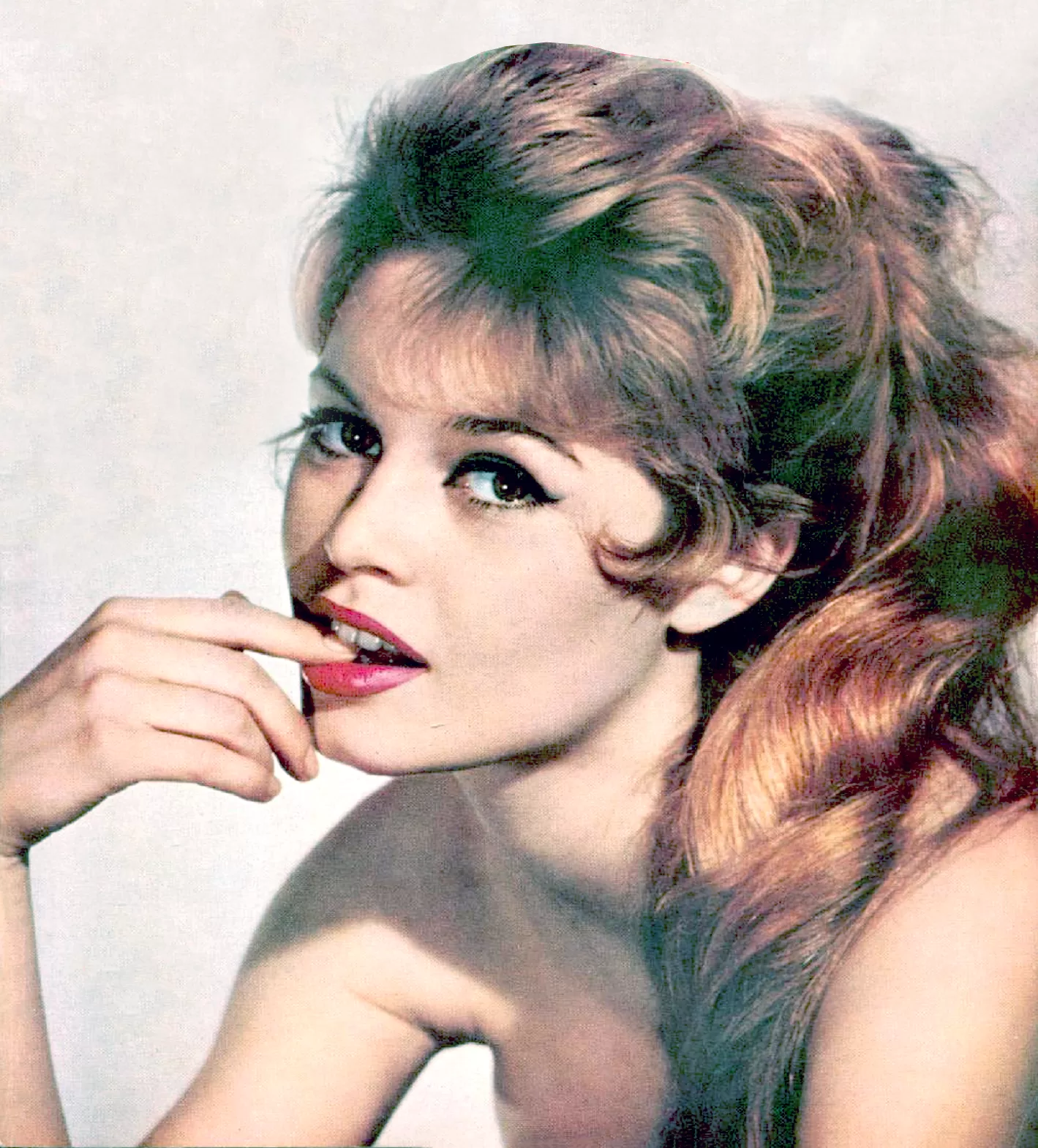
If France were a woman, she’d be Brigitte Bardot.
With her sex appeal, classy yet norm-defying fashion sense, curvaceous figure, and carefree approach to life, Brigitte Bardot embodied French femininity as no one else could. Perhaps more than any other actress of her era, she was in control of her own sexuality, thoughts, and notably, style. Her entire lifestyle amounted to a philosophical manifesto, one that took women’s liberation to a whole other level. French historian and cinema critic Jacque Siclier described her as ‘the only authentic myth of a woman that has ever existed in French cinema. In 1957, the woman of French cinema is Brigitte Bardot and no other.’
She represented France as no other. From 1969 to 1978, Bardot was the official face of Marianne, the Goddess of Liberty and national symbol of the French Republic. President Charles Degaulle had declared Bardot as “the French export as important as Renault cars.” Like any femme fatale, she generated her share of controversy, but then no well-behaved woman has ever made history.
As a young girl, Bardot studied ballet at the Paris Conservatory (her fellow dance mate, Leslie Caron, would later star alongside Gene Kelly in An American in Paris), developing the elegant poise and carriage that would become one of her trademarks. Bardot’s modeling career began as a teenager, when she started posing for friends of her mother. While there was fashion for married women and little girls, there was nothing in between – teenage fashion was nonexistent. All that changed when Bardot appeared on the cover of French Elle in 1950. “Women of my generation all remember her first cover on Elle in 1950,” remembers French fashion historian Nicole Parrot. “She had the magnificent posture of a dancer and represented something that had never had its place before in society or in fashion: that of the jeune fille.” She was a new kind of blonde bombshell to emerge in a Europe still recovering from the ravages of war.
In 1957, at the age of 23, she was cast as Juliette in And God Created Woman, her husband, Roger Vadim’s, seminal film. While Bardot’s Juliette was a woman with exploding sensuality, she was never lewd and was just as full of innocence. In fact, the moniker “sex kitten” was invented for Bardot in 1958. The film was a huge success and turned Bardot into an international star; her sexually charged performance, in which she dances barefoot with her hair wild and loose, skin glowing with beads of sweat to the sound of furious carioca, became a defining moment in cinematic history.
And God Created Woman created a scandal in the U.S. The film was banned in some states, and movie managers who dared to show it were prosecuted. Religious groups blasted Bardot as a creation not of God, but the devil, having a corrupting effect on the nation’s youth. Even so, the film’s box-office success soared, and the furor traveled back to Europe.
In 1958, Raymond Cartier, editor at the time of Paris Match, embarked on an investigation of the Bardot phenomenon. He summoned psychologists, anthropologists, and sociologists to try to uncover the roots of the obsession with Bardot, asking what lessons could be drawn about “the modern crowd’s psychology and the evolution of today’s mores” to turn back the tide. By the end of his eight-page investigation, Cartier concluded: “Bardot is immoral, from head to toe.” Agreeing with the American censors, he declared: Ban Bardot.
In her 1959 essay titled Brigitte Bardot and The Lolita Syndrome, Simone de Beauvoir called Bardot the “locomotive of women’s history.” She compared Bardot’s eruption into French society with existentialism, presenting Bardot as the first and most liberated woman of post-war France. “A liberated woman is the opposite of an easy and frivolous woman,” wrote De Beauvoir. “Bardot’s naturalness seems more perverse than any kind of sophistication. To despise as she does jewels, makeup, and high heels is to refuse to transform oneself into an idol. It is to assert oneself as the equal of men. It is to recognize that between men and women, there is only desire and mutual pleasure. This is precisely what made her appear so dangerous in the eyes of society.”
“She is the first woman to have publicly displayed her sexual freedom,” says biographer Marie-Dominique Lelievre. “Unlike Hollywood actresses who played by the rules, Bardot set her own. She attracted women who wanted to do like her, and men who simply wanted her.”
But perhaps most striking of all is how closely Bardot reflected signs of the times in France. According to Sarah Leahy, in her films of the mid to late 1950s, we can see her embodying a pure surface, eradicating the war’s stains on the female body. By presenting the female body for the gaze in such a way, the sullied post-war body (which is marked by male anxieties and violence) is cleansed. How a woman embodies the soul of her country!
In film and fashion, Bardot is credited with launching trends. She was ahead of her time in many ways, with a style that largely influenced the fashion and beauty world.
The Bardot neckline – a wide-open neck that exposes both of a woman’s shoulders and her collarbone – is named after her. Bardot popularized this style, which is used for various tops and dresses, single-handedly making off-the-shoulder shirts chic!
The Bardot Pose – a modeling pose shot around 1960, where Bardot is dressed only in a pair of black pantyhose, with her legs crossed over her front and arms crossed over her breasts. The iconic pose has been emulated numerous times by models and celebrities, including Monica Bellucci, Lindsay Lohan, Rihanna, and Elle MacPherson.
The Bikini – Bardot popularized the bikini in Europe. She sported the swimwear in the 1952 film Marina, the Girl in the Bikini, one of the first times the bikini appeared in a movie. The following year, she made her debut at the Cannes Film Festival, appearing in a bikini on the beach. It worked so well for her that she repeatedly wore bikinis in And God Created Woman. While the bikini became relatively well accepted in Europe in the 1950s, it was still considered risqué in the United States. Bardot’s films managed to skirt the U.S prohibition at the time against bare midriffs, as they were foreign films.
Riviera Chic – Through films such as The Girl in the Bikini and her regular appearances at St. Tropez and the Cannes Film Festival, Bardot romanticized travel to the French Riviera, which, to this day, remains a fashionable holiday destination. “Riviera chic” was a laid-back, sophisticated style inspired by Bardot: striped shirts, cropped pants, and bikinis, paired with slight tans, are among the signature looks of the Riviera.
Bardot also put gingham on the map after wearing a checkered pink gingham wedding dress in 1959, designed by Jacques Esterel.
Ballerina Flats – As a former ballet dancer, Bardot asked designer Rose Repetto (and founder of French footwear brand Repetto) to make shoes as light as her dance slippers for her role in And God Created Woman. And so, the everyday ballerina flat was born, having been taken from the stage to the street. “She was the spark that set things off,” said Jean-Marc Gaucher, Repetto’s CEO. “People wanted to have the same product as her. She became the symbol of women’s emancipation. She broke with the codes of the era.” The Repetto brand is best known for its ballerina flats, made famous by Bardot, and remains a go-to fashion house for the likes of Sarah Jessica Parker and Kate Moss.
Other dance-inspired elements that appear throughout Bardot’s films and daily wardrobe include leotards, hairbands, and ballerina skirts.
The Original Bedhead – Bardot was arguably the first to make messy hair chic. No one defined sexy, feminine, flirty hair like Bardot! Her roughed-up, bed-head look became her trademark and remains an inspiration to the younger generation and to figures such as Kate Moss, Blake Lively, Georgia Jagger, and Bella Hadid. “Brigitte Bardot was doing the bedhead before it was even a style,” says Orlando Pita of BioSilk Hair Care, who was inspired to create a modern-day Bardot for a messy, undone, sexy but modern look.
Her signature messy updo, cat eye makeup, and sexy nude pout are still emulated in photo shoots today. The bouffant, worn by actresses such as herself and Catherine Deneuve, reimagined 1960s sensuality, particularly when paired with a wing of black eyeliner. Bardot popularized thick, winged eyeliner worldwide, and half a century later, its popularity shows no sign of waning.
Bardot’s look was unusual in the posh celebrity circles she inhabited, with a style that liberated women from the bourgeois confines of structured clothing and expensive gowns. She fashioned simple, inexpensive clothing, wearing little jewelry and no gloves, and choosing breezy cotton over heavy silk. She often walked around barefoot and wore miniskirts to the Elysee Palace. Jean-Claude Jitrois, who dressed Bardot in the ‘80s, describes her signature style as “chic-destroy.” “It’s coming back,” he comments. “We are going to see those years come back in fashion. Young people like the way she said ‘merde’ to the bourgeoisie and love the ‘And God Created Woman’ style, that certain type of elegance.”
Bardot says, “I gave a new image of the way you should be in life and in the movies: blonde, free, not stuffy, not hung up, not like a little lady’s maid, no little corset, no little collar, but stark naked.
“I used to show my behind at a time when you were not supposed to show your behind; it was very shocking. Well, now it has become an absolutely normal occurrence!”
The effortlessness of “the Bardot look” was something many women aspired to achieve. In the feminist era of the 1960s, a female figure such as Bardot was a model to emulate. Her easy hair and makeup, and way of dressing her body – staying true to her womanly form and feminine curves – embodied female empowerment. She represents a woman who is unafraid to be herself, a woman who confidently utilizes her sensuality yet remains assertive. Bardot’s sexually free but innocent persona carved out a new type of female, the ‘sex kitten.’
The sexiest outfits are sometimes the simplest – Bardot never dressed in the grandeur of the likes of Elizabeth Taylor or Marlene Dietrich. Her sex appeal did not depend entirely on low-cut tops and short skirts. She knew how to make everything from a T-shirt and jeans to a skirt suit look like the sexiest item ever!
Decades later, women around the world still aspire to dress exactly as she did. Trends she started in her heyday continue to have an enduring impact on fashion. One of the most striking things about looking at photos of Bardot from the ‘60s and ‘70s is how timeless her outfits look even today. It is a great reminder that staying away from trends and sticking with a signature style is what ultimately stands the test of time!
True fashion icons do not rely solely on their beauty but on their ability to inspire through their style, charisma, and approach to life. “To be successful and noticed, you must stand out,” says Orlando Pita. “If you create looks like everyone else or stick to trends, no one will take notice of what you are doing. To stand out, you must create something unique.”