
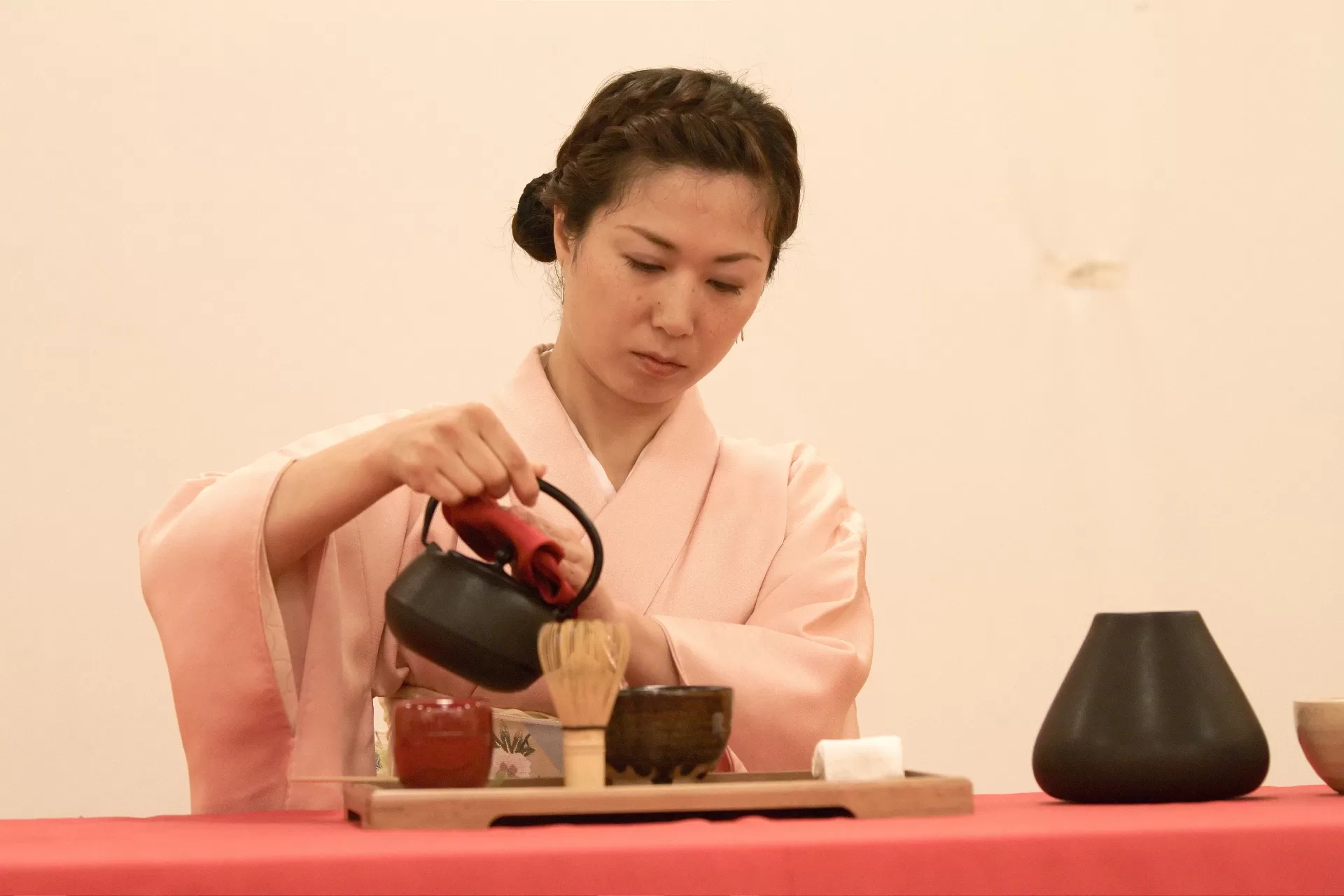
Under the late afternoon sun in a clearing surrounded by greenery and art sculptures, three Japanese women in traditional garb set up tea equipment on a table and quietly murmur among themselves. One is dressed in a dark blue kimono with white flowers; another in pistachio green; and the third in cherry red. Each lays out a selection of tea utensils on the tabletop and sets up five chairs behind another table nearby. They smile at each other and continue chatting in Japanese as an audience gathers.
Hospitality is a central characteristic of Oriental culture, and today we see it transformed into an art. In this case, it is the making and serving of a cup of tea, which in Japan is performed in the most polite, graceful, and charming way.
The Sculpture Garden at the Knox Albright Art Gallery slowly fills with people eager to witness a Japanese tea ceremony. In Japan, the tea ceremony is a highly regarded ritual practiced for centuries and remains integral to Japanese culture.
The woman in the dark blue kimono, about 60, petite, with her black hair in a pageboy, greets the visitors.
Takako Michii has lived in Buffalo for 41 years. She established the Japanese program at SUNY Buffalo and has taught art history for 15 years in the U.S., China, and Japan. She is also involved in cultural and educational exchange between the U.S. and Japan.
Because she is soft-spoken, the audience of about 30 has to move closer to hear better. The other two women, with their hair tied in buns, stand nearby. They are both much younger than Takako and serve as her assistants.
“The tea ceremony in Japan was developed under the philosophy of Zen Buddhism and is considered to be the epitome of Japanese culture,” says Takako. “The paintings, calligraphy hangings, and flower arrangements, along with the tea itself and the manner in which everything is observed and prepared is considered an offering to God. The tea ceremony signifies the union of art, creativity, nature, religion, and social exchange.”
The woman in the green kimono sits behind the tea table. Arranged on the table are a small white linen cloth, a ceramic tea bowl, a small black caddy containing powdered green tea, a tea scoop and a tea whisk, both made of bamboo, and a large electric iron pot for boiling water.
Takako invites four people from the audience to come up and act as guests at the ceremony. Four women go up and sit in chairs behind the other table, and Takako sits in the fifth chair.
Michiko, the woman in the red kimono, approaches them with a tray holding five napkins, each with a pink and a yellow candy. She bows her head to Takako before placing the napkin in front of her, and Takako bows her head in return. She then places the other napkins in front of the four women, bows to each, hands them the candies, and each woman bows after receiving her candy.
“A Japanese tea ceremony is observed in a spirit of serenity and meditation, and most tea ceremonies involve no talking. Normally, in a tea room, none of the guests would have on jewelry or perfume, but it is customary to burn incense during a ceremony,” explains Takako.
As the water in the large pot comes to a boil, Mei, the woman in green, takes out a red square cloth. She delicately wipes the top of the black tea caddy and the small wooden spoon, then places the spoon on the caddy. She takes the long wooden tea scoop, dips it into the iron pot, lifts it out, and sets it on top of a blue ceramic holder. She bows her head to Takako, who takes the two candies and pops them into her mouth, while the other women do the same. They all bow their heads back to Mei.
“It’s all so serious,” whispers Cynthia, a Buffalo State graduate student taking notes during the ceremony. “But it’s interesting all the same.”
Takako explains that a typical Japanese tea room would be clean, with the floor covered in special straw mats called Tatami. The room would be adorned with flower arrangements, with calligraphy hanging from the walls. “Guests would sit on the floor and have tea on short wooden tables,” she says. “They would be required to wash their mouths and hands before entering a tea room.”
Women typically wear kimonos, and men wear traditional hakama pants during tea ceremonies.
Michiko brings out a tray holding a gray ceramic bowl, bows her head, and hands the bowl to Mei, who bows in return and daintily wipes it with the red cloth. Mei removes the lid of the tea caddy, takes two spoonfuls of powdered green tea with the small wooden spoon, and pours the tea into the bowl. She dips the long wooden spoon into the iron pot and pours boiling water into the bowl, mixing the contents vigorously with the tea whisk. She hands the bowl back to Michiko, and they exchange bows.
Michiko sets the bowl on a red-and-white napkin and takes it over to Takako, bowing her head. Takako gently lifts the bowl to her lips, slowly sipping the contents, and bows her head.
The same procedure is repeated for each of the four guests, conducted in a serious, meditative manner.
While the women are being served, Takako points out facts every few moments.
“It was – and still is – customary for politicians in Japan to have discussions in a tea room and to make decisions in a meditative spirit, detached from the outside world,” she says.
Tea ceremonies are also a ritual of hospitality, a way to enjoy and nurture friendships. “Special occasions like the new year, birthdays, and weddings are usually accompanied by a tea ceremony.”
There are numerous tea schools in Japan, and Takako herself has been a student. She enjoys sharing a special part of her culture with the world and is proud that Buffalo has a sister city in Japan, Kawasaki.
At the close of the ceremony, Mei announces that there will be a Japanese Culture Day at the Buffalo and Erie Botanical Gardens on November 2nd, featuring traditional Japanese dance, culinary demonstrations and tastings, and ceramic displays.
“Harmony, respect, purity, and tranquility are the four principles of a tea ceremony,” Takako clarifies. “Harmony between persons and objects leads to respect without distinction, which leads to spiritual purity. Tranquility is gained when we make harmony, respect, and purity our own.”
She thanks the audience for coming and, along with Michiko and Mei, bows her head to applause.
Michiko offers to serve the rest of the tea to the remaining audience members. Five of us sit down to drink the tea from ceramic bowls, which, when seen up close, have a design on one side. Michiko tells us that the bowl is to be served so that the design always faces the guest.
My bowl features a flower in shades of pink, yellow, and white. The tea is bright green and has an organic, natural taste, almost like trees.
“I admire the tranquility and order that is conveyed in the tea ceremony,” says Kathy, a woman in the audience. “Every movement is done intentionally and gracefully.”
Mei believes that a bowl of tea, when served with a respectful heart and received with gratitude, satisfies both physical and spiritual thirst.
“When our minds and bodies are exhausted by the frenzied world and our own dilemmas, it is the discipline of Chado, or the Way of Tea, that helps us find peace and tranquility,” she mentions. “As a representative of this unbroken Japanese tradition of four hundred years, I am pleased to see that many non-Japanese show interest in pursuing its study.”