
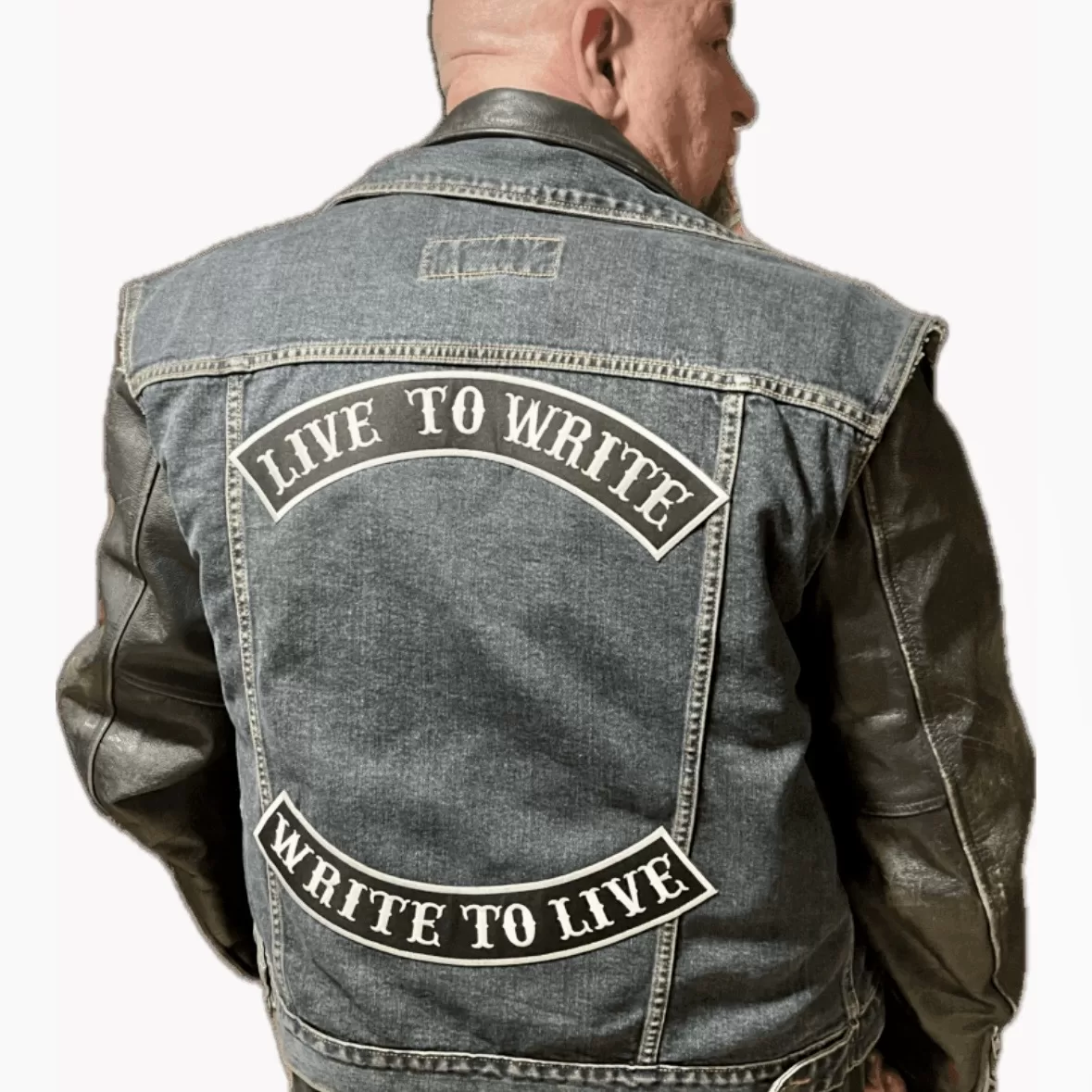
Students who have taken Andrew Galarneau’s journalism course often describe him as appearing rough.
Yet once they get to know him, they come to embrace his teaching style. They see him as a helpful, down-to-earth instructor who gives them the freedom to write feature articles on topics they are passionate about. While his main job is at the Buffalo News, he has been an adjunct instructor in journalism at the University at Buffalo since 2000.
“It’s interesting to explain to a class what you do every day,” he says. “I get the opportunity to justify the decisions I make as a journalist, and better examine what I do on the job.” If his students ever ask him for advice, he is more than happy to give it, and in his years as an instructor, he has offered plenty of tips on careers, journalism school, and feature writing.
Andrew attended the University at Buffalo from 1983 to 1988. His first journalistic experience was in 1984, when he co-founded the university’s Generation magazine, for which he served as editor-in-chief and columnist. He subsequently obtained internships at The Buffalo News and the Columbia Journalism Review at Columbia University.
What initially drew him to journalism was his passion for reading novels, and the hope of someday becoming a writer: “I came to UB thinking I was going to be a novelist because I love reading novels, and then I realized that most people do not make a living writing novels. However, I found out that I could work in journalism and get paid.”
He cites his favorite novel as The Silence of the Lambs, which he says reflects his interest in crime and punishment matters. So it comes as no surprise that when he took his first job in 1988, as a newspaper reporter in Concord, New Hampshire, he covered small towns and police cases for the Concord Monitor. From 1992 to 1995, he covered murder trials and courthouses for three years as a reporter for the St. Petersburg Times in St. Petersburg, Florida. He is also credited with covering part of the infamous O.J. Simpson murder trial in California.
In 1995, Andrew was hired as an investigative journalist by the Lowell Sun in Lowell, Massachusetts, and worked there until he joined The Buffalo News in October 1997. He has been a feature writer and investigative reporter for The Buffalo News, and is currently the food writer. “I had been writing about food, restaurants, and chefs on and off for 10 years. I actively lobbied for this job once I realized it would be open one day at The Buffalo News… you get to write about the things people eat and what they feed you, and that’s pretty awesome.” At the moment, there is a video clip of Andrew in the Gusto section of The Buffalo News website, in which he shows how to make an exotic Clementine Fennel Salad step by step.
He mentions that in his experience as a journalist, it is the stories one does not get to write that bother one the most, because there are always things one thinks are true but cannot necessarily prove. He has seen widespread corruption in Western New York and has observed politicians who spend public money on their own private affairs. One does not always get to write about these issues as they are difficult to prove, and in Andrew’s opinion, the officials who should root out white-collar crime and corruption are less than interested in doing so.
It does not stop him from trying, however. In his days working for the Lowell Sun, he wrote a series of investigative reports that were instrumental in convincing the Massachusetts legislature to put the state’s Middlesex County government out of existence. He showed in his stories how much money the officials were wasting and the kind of corruption that was going on. “I would say it was some of my best work because of the impact it had. I’ve written other stories that got people locked up in prison because they deserved to go to prison – that was pretty fun – I wrote a story in Niagara Falls that stopped some scumbags from opening up a chemical factory that they were going to run with no pollution control equipment, and without informing any of their neighbors. I felt pretty good about that story; people in the community were pretty happy.”
What made Andrew come back to Buffalo was that he could get a well-paying job there. He could work for people he knew he did not despise (he had grown fed up with the people he was working for in Massachusetts and was considering a career in public relations before he got the call from Buffalo). He says he had been trying to get back to the Buffalo News for five years, as his parents live in Williamsville, and he also knew many people in the area.
Beyond work, Andrew finds time to have a personal life. He has three children: Lydia, 14, Zoe, 11, and Jacob, 9. He was divorced from his wife last year after 17 years of marriage, and feels bad for the kids about it, although he says they have dealt well with the split. He tries to make it up to them by cooking their favorite meals, playing video games with them, and making them laugh. He is currently living with his new fiancée, whom he first met at the University at Buffalo before he was married. “So it’s a small world,” he says. “I’ve had a pretty good life, even though I did get divorced and stuff like that.”
Andrew has won numerous journalism awards, but one he likes to mention is the first place in the New York State Associated Press feature writing contest for a profile of Buffalo Sabres broadcaster Rick Jeanneret. An avid Sabres fan, writing this article allowed him to visit Jeanneret’s house and spend an entire day with him for the report. He is also part of the Sabres’ season ticket group and buys ten pairs of tickets a year to see the Sabres. He is not a fan of any of the other Buffalo sports organizations, as “they [can] break my heart only so many times.”
He believes that Generation magazine and the Spectrum newspaper have been doing well, considering undergraduates run them at a school without a BA program in journalism. He would like UB to have such a program, but knows that the SUNY officials will never heed such a petition. “My understanding is that you’d have to take a large number of the SUNY trustees hostage with machine guns to get a journalism program at UB,” he says. Attempts have been made to set up such a program at UB, but the basic message from Albany was that Buffalo State College already had a BA program in journalism. Apparently, the SUNY system lacks funds to start these kinds of programs, “unless it’s the hard sciences that bring in money like Engineering or Computer whatever or Earthquake hoo-ha,” he points out.
Andrew believes that it takes more than just knowing words and how to put words together to be successful as a journalist. In his opinion, anyone who wants to get into journalism or anything of that nature needs to be well-versed in all platforms. They not only have to know how to write but also need to be skilled in work such as editing, video packaging, and putting together a decent website. Being familiar with Facebook and Twitter can also come in handy.
Andrew keeps in touch with his former students, who, by now, have become his friends and are pursuing careers in writing, public relations, media, and journalism. At times, he is asked whether he thinks pursuing a master’s degree in journalism is worthwhile. “Whether a graduate degree in journalism is a good investment depends on your resources. It can be an expensive way to make social contacts. My basic advice is if you have the time and money – not borrow one hundred percent – it makes sense to do it.” He recommends getting a job in the field for a little while before going to graduate school, as one can learn the ropes of the business much faster.
He says that his experience working with Generation was a good start for his career as a journalist. “I was 17 back then; I’m 44 now. I definitely learned a lot from the experience. And one of the things I learned which has stuck with me is that 9 out of 10 people are just fakin’ it until they makin’ it. And you can fake it too, just don’t let them see you sweat. Just pretend you know what you’re doing until somebody says ‘Hey, what are you doing?’ And you know what? It hardly ever happens.”