
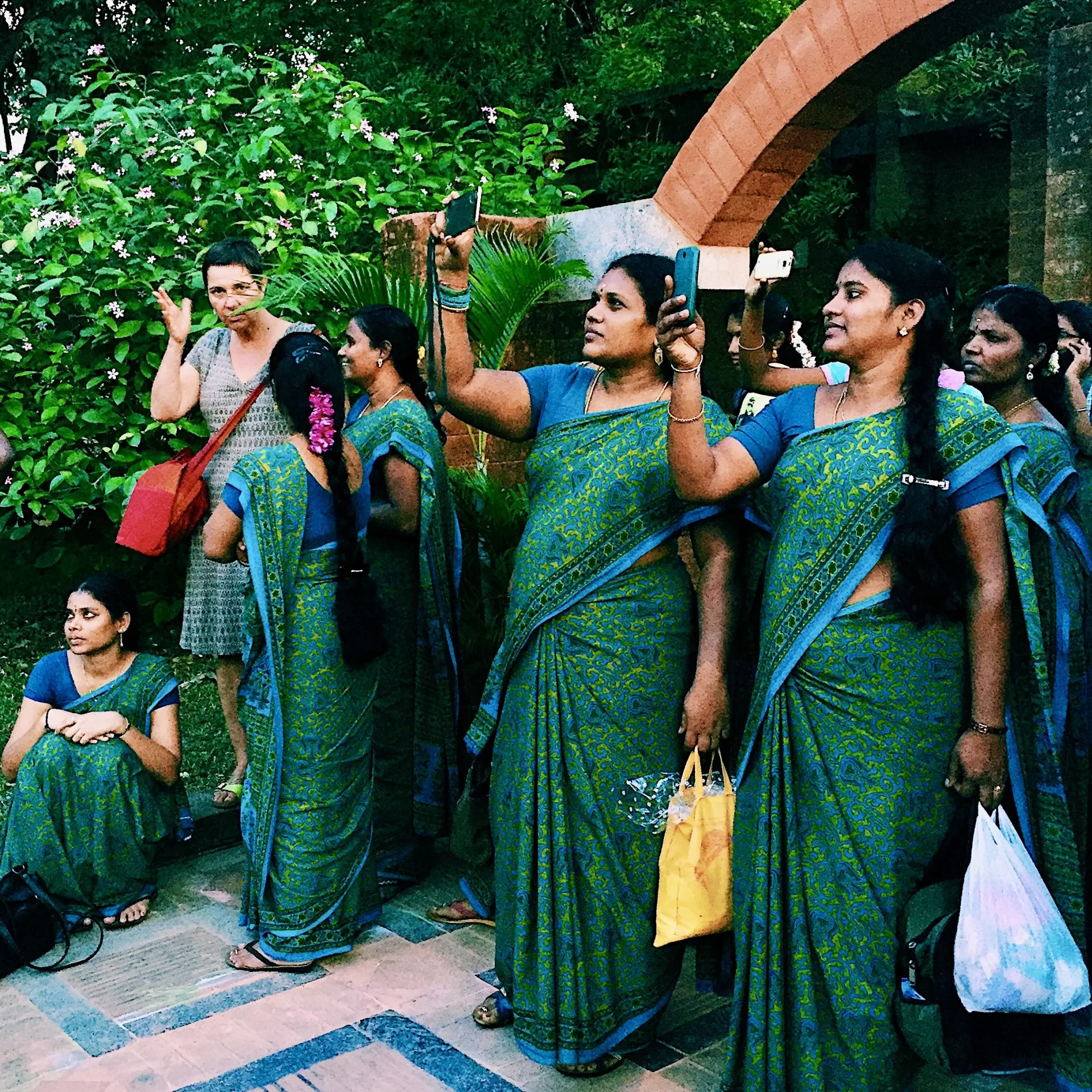
Visiting the southern Indian state of Tamil Nadu during winter break afforded me the opportunity to examine gender equality and women’s empowerment in the region.
According to the Foundation for Sustainable Development, gender discrimination continues to be a problem in India. Indian society is generally patriarchal, and the social environment can be abusive of women, not allowing them as many rights. Traditional patriarchal norms can relegate women to secondary status within the household and workplace.
Concepts of gender equality and women’s empowerment align with the broader theme of global feminism (as defined by the Multimedia Encyclopedia of Women in Today’s World): “the agenda of global feminism is to be able to respond to local-level concerns of women while integrating the goals of earlier feminist movements and their philosophies into their mission and actions.” Especially in a non-Western environment such as India, it is necessary to understand there is a distinction between the feminism that generally hails from the Western hemisphere, reflecting feminist though within a mostly Western context, and global feminism, which brings together “cultures and issues affecting women under a broad and unifying framework of feminist thought that has emerged from countries outside the Western hemisphere.”
It is best, nevertheless, to avoid essentializing and categorizing Indian women as ‘oppressed’ or ‘victimized’. At times, news publications intentionally or unintentionally approach the issue of gender inequality in India and other developing countries in an essentializing manner, downplaying the progress these countries are already making in this regard. Headlines such as “‘I was so scared…I was tortured’: Indian women lift the lid on married life” (The Guardian), or “11 facts about gender inequality in India that will truly shock you” (Buzzfeed) can overdramatize the issue.
It is best, nevertheless, to avoid essentializing and categorizing Indian women as ‘oppressed’ or ‘victimized’. At times, news publications intentionally or unintentionally approach the issue of gender inequality in India and other developing countries in an essentializing manner, downplaying the progress these countries are already making in this regard. Headlines such as “‘I was so scared…I was tortured’: Indian women lift the lid on married life” (The Guardian), or “11 facts about gender inequality in India that will truly shock you” (Buzzfeed) can overdramatize the issue.
Observing the interactions of my female colleagues at my internship site in Pondicherry, I became aware of societal and interpersonal issues affecting modern and educated Indian women in the workplace. Hearing their conversations with each other or with their male colleagues, I realized how they were realizing their potential as modern Indian women, strengthening their voices and discovering their place in society. For the most part, I observed a spirit of camaraderie among girls and guys, even when they did not entirely agree on everything. It was good that the guys were able to interact with their female colleagues and hear them out. I remember Siddharth explaining that, in his youth, he was sexist; since coming to Auroville and being exposed to the Mother’s legacy, he has learned to embrace and value feminine energy, ultimately becoming an advocate for women’s empowerment. Reflecting on my time in India, I would conclude that many issues affecting modern Indian women are common to modern women anywhere.
Several Bollywood actresses are known for championing women’s rights and for taking on on-screen roles that present Indian women in a new light. Priyanka Chopra is vocal about the pay gap in her country and the Indian film industry, having no qualms in stating how women around the world need emancipation. In her Vogue India video My Choice, Deepika Padukone conveys a message of empowerment for Indian women, emphasizing the choices women must be allowed to make to achieve equality. Vidya Balan is known for portraying strong female protagonists and is acknowledged for pioneering a change in the concept of an Indian film heroine. Veteran Bollywood actor Shah Rukh Khan has his own take on feminism: “If being feminist means equality, then I’m not one. I believe women should be more than us. If you’re looking at being equal to us, your aim is too low—you’re belittling yourself. It’s shocking how much a woman must take every day…as men, we should all experience what it is like and still stay strong. To me, you are far superior to men.”
The feminist movement in India has gained momentum in the past few years, especially after the infamous Delhi gang rape in 2012. Mass protests for women’s rights took place almost overnight after the incident, and those who voiced the ‘old attitudes’ were met with condemnation. The Indian government’s actions were swift, establishing legal changes not only against rape but also against acid attacks, child sexual abuse, the practice of stripping and humiliating women in public, the abuse of women by army officials in conflict areas, and rape within marriage. There was a noticeable shift in how female characters were portrayed in Indian television serials: women were no longer confined to traditional daughter-in-law roles or romantic plotlines. BBC Radio presenter Anita Anand writes, “In a land that worships goddesses in temples, it seems finally as if flesh and blood women are on the verge of getting better treatment than their mothers. Why? Because they are asking for it.”
In 2013, the Indian Ministry of Tourism launched a video for Incredible India, an international marketing campaign by the Indian government promoting India as a popular tourist destination. The video featured a Western female tourist in India engaging in thrill-seeking activities, such as motorbiking, skydiving, swimming with elephants, and rock climbing, while immersing herself in more traditional Indian elements, including Ayurvedic massages, yoga, and drinking coconut milk. The video was hugely successful, and as it was launched one year after the Delhi incident, it did very well in dispelling any rumor of India as an unsafe and inhospitable place for women. Traveling to India becomes a story of self-realization, a transformational experience as seen through the eyes of a woman. The feminization of the travel experience is not only celebrated but also presented as something highly desirable.
The Incredible India clip undoubtedly did its job to attract potential tourists. A tourist is someone with special status – they are to be served and catered to. The protagonist in the clip is constantly catering to her own desires and surrounded by the hospitality of locals. She is also a Westerner, which raises the question of whether the clip achieved the same level of success among non-Western audiences. Does it merely represent India as seen through the eyes of a particular type of Westerner or foreigner? What would it have looked like if the protagonist were Indian or a person of color?
In India, progress toward women’s empowerment and gender equality is achieved when women themselves serve as role models. According to an MIT study, female politicians in India inspire Indian women to pursue more education.
Priyanka Chopra’s title role in Mary Kom, a biopic of the real-life Indian boxing champion, in which she plays a fearless woman who becomes an icon through her pursuit of sporting excellence, may inspire Indian women more than non-Indian films with similar female protagonists. Amisha Patel’s tweeting about menstruation, giving examples of her life that imply she is no different than millions of her countrywomen who have been conditioned to believe menstruation is a taboo subject, may influence Indian women much more than a Western female celebrity raising awareness about the issue. Indian women may also identify with Madhuri Dixit’s role in the film Gulaab Gang, which depicts a women’s liberation movement in the northern Indian state of Uttar Pradesh, more than with Hollywood films on similar topics. Aishwarya Rai’s status as ambassador for L’Oreal, the world’s leading cosmetic brand, may inspire Indian women to believe in their own beauty more than non-Indian L’Oreal ambassadors.
Equations are changing in contemporary India. The modern Indian woman is becoming free to make her own choices, earn her own living, and be defined in her own right. The most important value for her is freedom. Yet she may be reeling from the memory of her gender’s subjugation by men, knowing that her mother’s generation and the generations before derived their self-worth and identity from their family and society.
In the past few years, there has been a rise in online feminist campaigns in India, through which Indian women, feminists, and activists can have their voices heard and raise awareness on gender-related issues:
The Spoilt Modern Indian Woman is an interactive feminist initiative that aims to “redefine gender and reclaim the narrative,” challenging and breaking gender related stereotypes affecting not only women, but LGBT individuals, sexual minorities, and men. Issues tackled by the initiative include casual sexism, body shaming, gender violence, harassment, rape culture, women’s empowerment, menstruation stigma, and patriarchal heteronormativity. Readers and followers may share personal stories on the SMIW website. The SMIW Facebook page, with over 66,000 followers, uses memes to call out sexist stereotypes that Indian women face in their everyday lives.
Two Indian women, Pankhuri Awasthi and Uppekha Jain, took the Internet by storm in 2015 when they called themselves ‘Bombaebs’ and released a rap on YouTube about sexual violence in India. In the three-minute video, where they speak in a mixture of English and Hindi, they approach issues such as rape, female infanticide, clothing, marriage, and women walking alone at night. The two urge their fellow Indians to “Get up on your feet and help reform his mindset/ that has been preset/ that women are nothing more than objects/ to be controlled, shut up, and used for sex.”
In 2014, the I Need Feminism campaign was launched at the Indira Gandhi Institute of Technology and Ambedkar University in Delhi. The campaign, which asks people why feminism is important to them, features a collection of photographs of individuals expressing their opinions about feminism. Both young men and women hold placards displaying slogans against gender discrimination and societal and cultural stereotypes.
The Feminism in India portal is an intersectional platform aimed at developing a feminist consciousness among Indian youth, to “unravel the F-word and demystify all the negativity surrounding it.” As India’s first feminist portal, it has created a new media community platform for Indians to break their silence and raise their voices on gender-related issues. All founders, editors, and staff members of the platform are Indian women, and FII has won web-campaign awards and online women’s-empowerment awards in India.
The Digital Hifazat campaign is geared to combat cyber violence against women in India. Online abuse affects over 50% of Indian women using social media. According to research conducted in collaboration with Freedom House, many Indian women avoid reporting such behavior as they believe complaining is of no use. Among the topics that invite online violence in India, feminism comes in first place. It is an unprecedented attempt made to collect data about the kind of vitriol faced by women on Indian social media, how it makes them feel, what content they post is most often targeted, and how they can counter the problem.
Multimedia platforms, communications outlets, and online campaigns can play a significant role in women’s empowerment. I would also argue that women becoming knowledgeable about and gaining skills in media production – a cultural activity that remains male-dominated – is equally important. According to media and gender studies scholar Mary Celeste Kearney, women’s engagement in such practices remains minimal worldwide, and until recently, the dominant assumption about girls’ relationship to media production was that girls do not make media; they consume it. Ammu Joseph, an Indian journalist, author, and media analyst, argues that in many parts of the world, women remain major consumers of cultural goods and constitute the majority of students enrolled in university courses related to culture. However, glass walls and ceilings still block their entry into culture-related careers and into decision-making positions within the creative sector.
Women can significantly enhance their leadership by expanding their mission through media production. Knowing how to craft a compelling media story and develop a media project – whether the project is a short film, documentary, promotional video, or social media campaign – is invaluable in a modern woman’s life, and central to feminism, globalization, or global feminism. In today’s world, globalization is closely tied to communications and media, and women are playing an ever more significant role in determining the course of globalization – nowadays, over 50% of international migration is by women. Therefore, women’s involvement in creating and producing media in today’s media age is more crucial than ever.