
Village Kollam Walk (Dec. 29)
I know that I’ll always look back on this day with awe and gratitude. For me, it was a glimpse into a world that is rapidly vanishing in the modern digital age.
While seven of us had signed up for the walk, only Sarah and I showed up – apparently, the 5:30 wake-up was harder than some could handle. The cab Sacha had reserved was no longer necessary, so the two of us piled onto the back of his motorcycle in true Indian style, and off we went to Verite in the twilight. The morning chants could be heard from afar, and it was my first time learning that they were a religious ritual to begin the day, usually starting at 5 am and lasting over two hours.
We met with Balu at Verite, then set off toward the village, where he served as our guide. Of course, it was great to reunite with Balu, and he was as inspiring on this walk as he had been at Mohanam, passionately discussing his culture and heritage. The purpose of this walk was to observe the unique Tamil tradition of creating kollams.
Each day before sunrise, Tamil women wake up and clean the entrance of their homes, welcoming the gods. They then create kollams – intricate geometric designs made of rice powder – as their emotions and inner creativity lead them. As Balu explained, this tradition is often passed down within the family from mother to daughter, with daughters typically learning the skill by seventh grade. It is a female custom that represents creation through creativity, honoring the Divine.
We passed women hard at work creating designs as the day broke, amid the chants from afar, the crowing of roosters, and the mooing of cows. It was the perfect scene of Tamil village life. Women gathering at wells to collect water in their jugs, residents welcoming us as we walked by, and receiving an invitation from a local Brahmin priest to come inside a temple to observe his morning devotional ritual are not what I experience regularly. While the standards of living where I come from are considered privileged by many, I was the one who felt privileged that morning to observe this rustic paradise.
Meanwhile, Sacha and Balu shared with us how this village brought back memories of their childhood. Balu’s recounting of how the family would all sleep in one room while his grandmother told bedtime stories reminded me of my own childhood with my grandmother, falling asleep to her stories. He lamented that even in India, modern life was eroding the sense of community one finds in such places, and that future generations, heavily influenced by digitalization, might never know such interpersonal and communal bonds.
As for the kollams, they embody how women’s creativity and dedication in the arts bring unparalleled beauty to the world. Many may boast of having taken a village walk, but this unique feminine tradition was the reason and motivation for ours. It serves as a reminder that women everywhere – even in a remote village in rural India – have infinite power in changing the world for the better.
Buying a Sari (Dec. 27)
I’ll admit it – for a long time, I’ve wanted to own a sari. Maybe it’s because of the years of watching Bollywood movies and admiring film heroines such as Aishwarya Rai and Preity Zinta in their dramatic poses and intriguing facial expressions, all draped in colorful saris, which only heightens the thrill. But beyond Bollywood galore, the sari itself has never failed to inspire me. All Indian women wear saris, regardless of class or caste, though in many places today the sari is increasingly being replaced by Western clothing. In Tamil Nadu, thankfully, there are still plenty of women who wear it. Although wearing a sari all day is not entirely convenient, especially for students or professionals, few garments embody the essence of femininity better than a sari.
I never saw any saris in Auroville shops, so I made sure to check out the stores in Pondicherry on the day we made our round of visits to NGOs there. I found a white sari with purple flower patterns, and one of the ladies at the store helped me tie it on – there was no way I could do it on my own. There is a whole art to wrapping a sari, one that will take some time for foreigners like me to learn. As soon as I came out of the fitting room, everyone commented on how good it looked on me. I would have bought the sari if it weren’t for the fact that the seller didn’t have change for a 2000-rupee bill. Oh well.
I did not have the chance to shop for saris until a couple of weeks later, when the internship site I chose was in Pondicherry. One of my colleagues was kind enough to give me a ride on his motorcycle to a popular sari store in town. After trying on five saris in different colors – again, a female employee helped me try them on – I decided on a dark pink and turquoise sari with floral patterns. It was more expensive than the one I planned to buy on my previous visit to Pondicherry, but it was worth it – it looked good on me, and what is the point of buying a sari anywhere but in India? Who knows if I ever come back?
As I found out, buying the lengthy cloth you wrap around yourself is only the first step. A petticoat is worn beneath it, its color to match the base sari color as closely as possible. It is to be bought separately. Also, the shirt cloth that reaches to the navel is included in the sari, but a tailor must stitch it for you. I will add that no one at the store spoke English, and my colleague was courteous enough to stay with me the whole time, acting as a translator there and in the tailor’s shop we found afterward, where English was not spoken either.
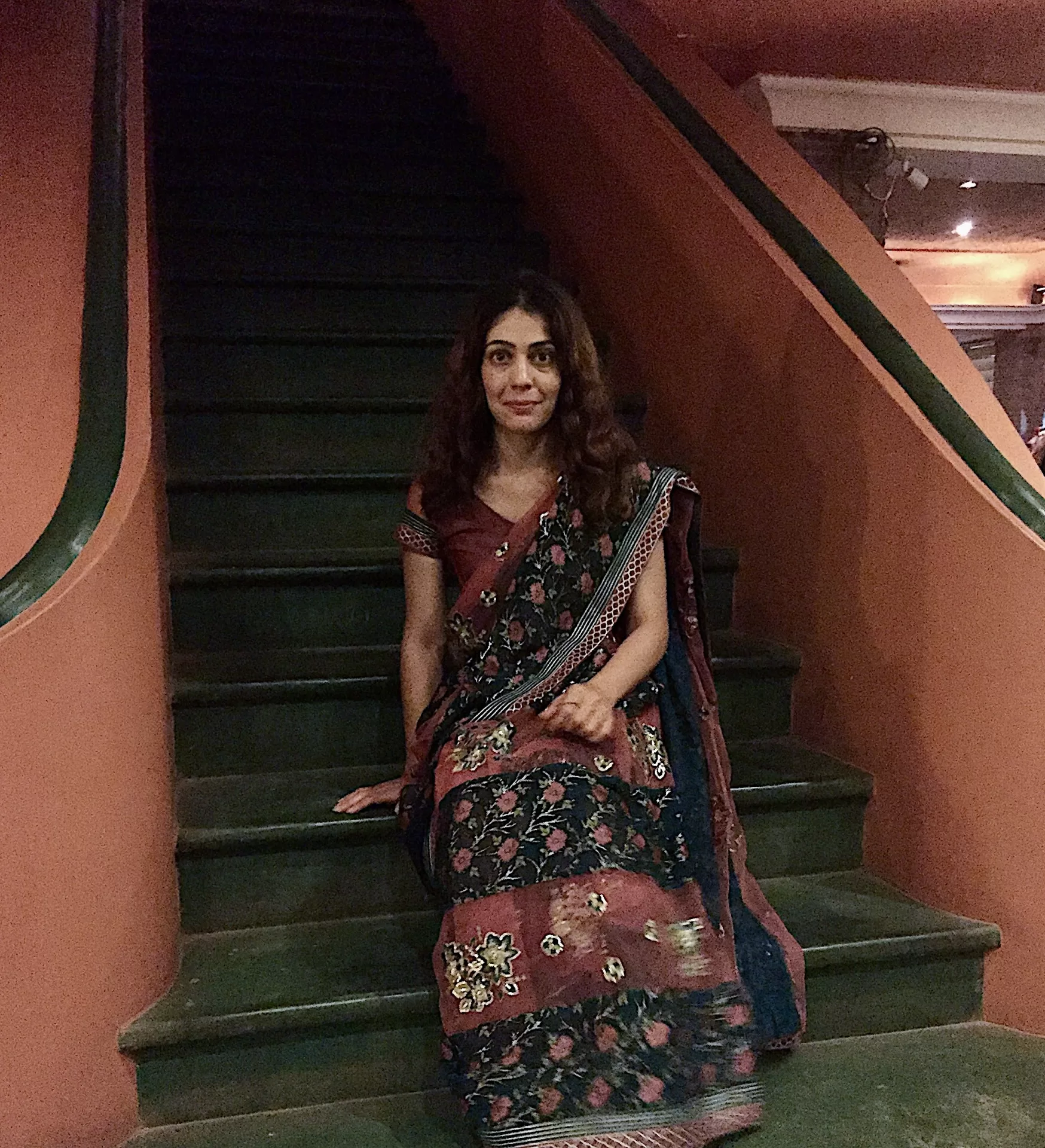
My sari is now officially ready to wear. I am proud to own a uniquely Indian garment, which I bought in a uniquely Indian way – my colleague in Pondicherry truly demonstrated Indian hospitality to me that day. I plan to wear the sari on my final day in India, when all of us at AUP will give presentations on our internship work in Auroville’s town hall. But I’m sure other opportunities will arise to wear my sari – perhaps at international events or at Indian celebrations. In these modern times, when the distinction between male and female qualities blurs, I am proud to own an item so uniquely feminine in every shape and form. In no way does this mean I am not for gender equality; only that I believe in taking pride in one’s femininity (or masculinity, if one happens to be male). For me, the sari gives me yet another reason to bask in femininity.
A Cup of Coffee (Dec. 25)
This one happened on a Sunday, a little over a week into our stay in India. It seemed like we were pretty much over our jet lag. Things were becoming more familiar to us, and we were becoming acquainted with the sights and sounds. We had spent almost all our time visiting potential internship sites around Auroville and Pondicherry. Yet on this day, I felt I needed to do something new, maybe separate myself from the group a little bit and do a little exploring on my own.
I ended up at the Visitor’s Center, which was busier than usual. I’m not sure if it gets like this every Sunday, but it seemed like a bus would stop every half hour, with loads of passengers streaming into the Center. Most of them were Indian, and I remember taking in the kaleidoscope of saris’ bright colors, the kind one is bound to see when there are masses of Indian women in one place. And everyone seemed clustered into families – a mother and father with children, a couple walking together, or grandparents in the mix – reflecting, in my opinion, India’s family-oriented culture. From time to time, there would be groups of friends or colleagues. And, of course, there were non-Indians, but what caught my eye most that day were the Indian families.
I had the opportunity to meet one such family that day. As I sat near the Center entrance, reading a book about Auroville, a couple with their young son was nearby. At one point, the husband turned to me and asked if I knew anything about Auroville. I replied that I was new here and was learning about the culture. It turned out they were new here as well, traveling all the way from Calcutta by train to visit an Auroville clinic for medical treatment. I already knew that Auroville was a distinct entity, separate from the greater Indian culture, but our conversation was unique in that we were all discovering Auroville together – they as Indians and me as a foreigner.
About half an hour into our encounter, the husband had ventured toward the Dreamer’s Café and was holding a cup of milk coffee when he returned, saying it was for me. I was so surprised that he would go to all that trouble, asking whether he or his wife did not want it, but he explained that, since I was in their country, I had to be treated as their guest. I was touched beyond words.
They left shortly after, as their bus had arrived to pick them up. I remember spending the rest of the afternoon in a daze, overwhelmed not so much by the act of generosity as by the sense of belonging it made possible with a simple cup of coffee. While I was new to India, during that conversation, I found common ground with an Indian family as we discovered this part of their country together. In that moment, their country had become my country.
The Mother envisioned Auroville as a place where all citizens of the world could find a sense of belonging, regardless of nationality. It makes me happy to realize that her dream was perpetuated that day, and I hope the many visitors drawn to Auroville have similar stories to tell. As for me, when sharing a moment with a kindred spirit over coffee in the future, I know I am bound to recount my serendipitous encounter in Auroville with the family from Calcutta.
May There Be Many More Forests to Grow People (Dec. 30)
Sadhana Forest was founded in 2003 by Aviram and Yorit Rozin. They came from Israel in search of a place where they could live according to their values, including using compostable products, veganism, nonviolence, and unschooling for their kids – a completely different concept of how kids learn. It is the idea that kids learn on their own; they do not have to be taught by anyone, and all it takes is creating an environment that allows them to maximize their creativity and discover what they are good at.
The Rozins had been living in Auroville for some time before realizing they could not find the sense of community they had hoped for. They sought to establish a noncommercial gift-economy culture in their community and ultimately founded their own place. As citizens of Auroville, they were given 70 acres of eroded, arid forest land on the city’s outskirts, with the goal of transforming it into a forest they named Sadhana Forest. Their initial goal was for Sadhana to accommodate families like their own, with reforestation as their selfless service to the world. One day, someone showed up expressing his wish to volunteer at Sadhana. It has been a volunteer project ever since.
There is a beautiful quote at Sadhana: “May there be many more forests to grow people.” The Rozin family still lives there and has worked tirelessly to advance their values of community, development, sustainability, food security, consciousness-raising, and reforestation. Sadhana is one of the largest residential volunteer projects in the world, with 100-150 volunteers a day during the high season and 1,000 volunteers a year. After a visitor to Sadhana said, “This is not only a project – this is a concept, so you can spread it,” the Rozins, along with their volunteers, started Sadhana Forests in Haiti and another in Kenya. Another branch will be established in Meghalaya, in northeastern India.
People from all over the world come to Sadhana to live and feel close to earth, developing a nature-connected life and a sense of community they cannot find anywhere else. The contributions of Sadhana volunteers to the sense of communal life are priceless. Sina, who ended up volunteering at Sadhana as part of a forestry internship, is glad she chose to come. “We wanted a place where we could stay as a family,” she says. “I’m here with my partner and my daughter, who’s two and a half years old. This is the perfect place for her; she enjoys it so much. After five days here, she decided this is the place – she loves it and feels at home here.” The family plans to go back home to Germany in March.
The Eco Film Night, held every Friday at Sadhana, is one of Auroville’s most popular community events, where people gather to watch films with themes related to Sadhana Forest, including the environment, natural history, and social issues. Before the screening, there is usually a tour of the Sadhana Forest project that explains its mission, achievements, challenges, and future aspirations. After the film, Sadhana volunteers serve a free vegan, organic dinner. Film Nights are open to any guest or local who would like to spend the evening at Sadhana and with the Sadhana community.
Matrimandir – the Soul of Auroville (Jan. 2)
I’ve visited many temples, shrines, and spiritual centers in my life, but nothing compares to today’s visit to Matrimandir. It is probably because Matrimandir is not your typical temple or building – how many are built as a singular gold sphere with twelve “petals” surrounding it, each containing meditation rooms? It also does not represent any particular religion or spiritual denomination. Matrimandir is unique in the sense that it is dedicated to the Universal Mother, a concept well known in Hindu culture. It is not a temple for the Mother of Auroville, as some may think, although she conceived the Matrimandir and provided precise instructions for its design and layout, based on a vision she had in 1970.
One must make a reservation to visit Matrimandir at least a couple of days in advance, and on the day of the visit, there is an orientation of sorts at Auroville’s Visitors Center. Visitors watch a short documentary on Auroville and the Matrimandir, then board a bus to the Matrimandir, where they leave their belongings at the door and receive a tour description from a guide. Total silence is required, with no talking whatsoever, as the purpose of being at Matrimandir is to concentrate and find one’s consciousness.
I don’t think I’ve ever been on a tour in which everyone was silent. Even in places like cathedrals where people tend to be quieter and contemplative, there is no such thing as utter silence for hours on end. What I experienced today was new to me in more ways than one, including being stripped of the bags, cell phones, and possessions we usually carry. The point is to gain freedom from all distractions and be present in the moment, which is needed more than ever in today’s hyper-digitalized, information-overloaded era.
We left our shoes at the entrance to the Matrimandir, and in silence we were led to the inner chamber at the heart of the structure. It is entirely white – the walls, the floor, the cushions, and the twelve columns, which stand halfway between the center and the walls. There are no flowers, no incense, no music, no talking, no rituals. Chanting, kneeling, or posing in any religious or non-religious form is not allowed – visitors can only sit on the white floor in concentration and contemplation. The chamber has no windows and is generally not lit, except for rays of light entering from the top to the center, where a glass globe – similar to a crystal ball – is located.
We sat in the chamber in silence for about twenty minutes. I was fixated on the globe for almost the whole time, pondering its meaning and the purpose of being here. I’m sure the experience of Matrimandir is subjective and open to interpretation, but it is meant to create consciousness among all who visit. The Mother had explained: “I will make it a very strong center, but only those who are capable will perceive it.”
The globe reminded me of an ancient Persian legend in which a king named Jamshid possessed a crystal ball that could show him any part of the world he wished. In the legend’s time, Persia was a multicultural hub, governed by rulers renowned for their compassion and tolerance toward citizens from all corners of the world. I perceived the glass globe at Matrimandir as representing world unity, unmarred by politics, religion, or national or cultural boundaries, in an area distinguished by its compassion for all people of goodwill, regardless of where they came from.
As we made our way toward the Garden of Unity, dominated by the large Banyan tree, I caught sight of a slogan, “Auroville la cite au service de le verite’.” I noticed a European woman sitting by a pool filled with white and pink flowers, amid lit candles, brushing away a tear every so often but smiling for the most part. She looked very much at peace, as did most people I observed. A young Indian man nearby sat in meditation, eyes closed. Families sat together or wandered around, in what seemed to me a joyful silence.
The Mother said, “Matrimandir will be the soul of Auroville. The sooner the soul is there, the better it will be for everybody.” The concept is universal, applying to anyone and everyone, anywhere – the sooner one finds the soul, the better. All seek the soul’s fulfillment, whether through work, religion, education, politics, or travel. It is nice to see how Auroville and especially Matrimandir embody this, and I, for one, am sure to have gotten one step closer to fulfillment after today’s visit to the Soul of Auroville.
Deepti
Flowers floating in bowls of water are a common table decoration in India.
It is the first thing I notice as I enter Deepti’s living room. She says these flower decorations, which are usually associated with one of the Indian gods, are traditionally offered in India. Most patterns feature a larger flower in the middle of the bowl, surrounded by smaller flowers. Mira Alfassa, the founder of Auroville and commonly known as “the Mother,” had special names for the flowers: the surrounding flowers she called “aspiration,” and the one in the middle, “progress.”
“So it’s an aspiration for progress,” Deepti says. “It’s saying things with flowers, creating the atmosphere by using flowers.”
Deepti says that from the time she was a girl growing up in North India, she asked questions, a habit that ultimately led her to Auroville. Her grandfather served in the British Indian Army and fought in the First and Second World Wars. After India’s independence, he became the first director general of medical services in the Indian Army. An independent thinker, he raised his children to be independent, sending them to boarding schools when they were little. His daughter, Deepti’s mother, became a doctor.
But he also had a spiritual quest that led him to spend a considerable amount of time at the Sivananda ashram in North India. He became friends with the swami (master) and wrote a book on Hindu spirituality. Many seekers from the ashram were regular guests in the family home as Deepti was growing up, but she ultimately came to question the spirituality they spoke of. While she believes India has a vast, comprehensive, and inclusive spiritual tradition spanning two millennia, the solution it offers is outside of life, one that takes you away from the earth. “And that I could not understand,” she says. “I loved life, I found this universe beautiful, and the idea that the solution is to abandon all that made no sense to me.”
Deepti was 16 when she came across the writings of Sri Aurobindo, the political activist-turned-spiritual guru. He argued that this life is not the end, that humanity is transitional, and that the idea of a life divine on earth is not only logical but also the intention of the manifest universe. For Deepti, it finally made sense because Aurobindo made his points with rational arguments. From that time, she felt her life had found its direction. At 19, she traveled to the Sri Aurobindo ashram in Pondicherry and eventually settled in nearby Auroville. For a young person like her, Auroville was the obvious place to go, an adventure into the unknown. In the 70s, there was very little in Auroville; everything was still being built, but the conditions were ideal for Deepti. “In an environment that’s not hierarchical, no one tells you what to do,” she says. “You’re free to discover it for yourself. That’s why and how I’m here.”
Deepti has been a teacher in Auroville for the past 30 years. One of Auroville’s experimental aspects is the development of a new education, and Deepti has been actively involved in this work. The aim of Aurovilian education, as influenced by the Mother’s beliefs, is to foster the growth of consciousness. “It is to always grow higher, wider, deeper, to dive deep into the profundities, you reach higher beyond yourself. That is the aim, and it is through recognizing that consciousness is present in every aspect of your nature, even down to your cells, and by intentionally working upon that.”
The Mother used the term “free progress” to describe this form of education, a process guided by the soul and not subject to habits, conventions, or preconceived ideas. In Auroville, education is not defined by utilitarian elements such as syllabi and grades. The aim is not to cultivate success, establish a career, or earn money, but to discover the secrets of the universe and of one’s own nature. “The why, the core questions have to be found within,” Deepti says. “And so education that includes that would be a comprehensive, integral education, but guided by something more profound. The mind becomes merely an instrument at the service of.”
The educational setting in Auroville is informal, one in which children are recognized as whole beings rather than empty vessels. The teacher is to evoke what’s within them as an observer, a listener, a conscious watcher. The teacher demonstrates what the child already has within by pointing it out and indicating a direction the child then follows. For Deepti, it is great fun because nothing is fixed; everything is to be discovered, and each moment is new.
I then raise the issue of sustainability with Deepti, a key focus of the practicum. Aurovilians believe that environmental conditions are a result of the state of our consciousness. Attempting to change conditions without changing consciousness will not work, and true sustainability can only come about through a spiritual change of consciousness. From the beginning, Auroville has been aimed at integral change, and environmental sustainability is a core pursuit of that.
“In the 60s, when we started, Mother said not to repeat the old mistakes of putting poisons into the earth, so we never used insecticides, pesticides, or fertilizers,” Deepti says. “It doesn’t make sense because you damage the earth.”
To develop a sustainable relationship with the earth, you’ve got to first build that relationship with yourself. Everything done in Auroville is constructed from the inside out. Individual self-care expands to the collective and then to the earth body. It’s a core reason for being.
Aurovilians are also working with cutting-edge technologies. Although there is an emphasis on connecting with nature and embracing a waste-free lifestyle, there is no denial of the modern world’s discoveries. Aurovilians know that to be a society at the cutting edge, one cannot go backward. You can’t reduce; you must include. So they are working with wind and solar technologies that can help them reach their goals of sustainability, or, in Deepti’s words, sustaining humanity on earth and all the other living species.
Another hot topic in the practicum was women’s empowerment, which I discuss with Deepti. While women can be mistreated in India, it is also a place where women are exalted. “We have a living tradition of seeing the earth as the mother, and the mother goddess is present in every corner of India, in every village,” she says. “In many ways, she is the one who sustains all manifestation.”
A woman in India is identified as such, and it is no accident that the Indian subcontinent has produced the most female leaders in the world. There are also matrilineal societies in India, and areas where property is controlled by the female line. But one could argue, in general, that Indian society is patriarchal. Because of this complexity, there are all kinds of possibilities.
In Deepti’s family, being female was never considered a handicap, and girls were celebrated from birth. Her own mother was a working woman, and from a young age Deepti was surrounded by women who were doctors or lawyers. Even in an Indian village culture, women are tough – they sustain the family and work very hard. But the social environment can be abusive toward women, denying them many rights.
However, Auroville has been a refuge for the downtrodden from the beginning. When women from the village came to Auroville – whether to a unit or as domestic workers in a house – they were empowered and able to earn their own money. According to Deepti, women loved coming to Auroville to work because they were immediately given status, recognition, and all the rights of workers. “Auroville, from the beginning, has given them whatever a worker would have as a right. There can be domestic situations that are exploitative in India, but not in Auroville.”
Many units in Auroville hire only women because they prefer it that way, believing women are better workers. NGOs like the Auroville Village Action Group have organized self-help groups for women and helped form women’s cooperatives, and this trend has spread to about a hundred villages in the Auroville area. Women can talk to each other, and as they hear each other’s life stories, they empower one another and ultimately rise above their circumstances. Women and those from lower castes have benefited from being in Auroville. However, Aurovilians are not into social work per se—they believe in evolving together, which is deeper, since the idea of helping the downtrodden can sometimes be tainted by ego. In Auroville, everyone grows together, and every individual counts.
I ask Deepti what it was like to lecture to our group on the first day.
“I don’t get to see you or know you well enough to evaluate. I just do the best I can in the circumstances. I allow myself to be guided by the moment. So when I ask everyone the questions, I hear not only the question but also what’s behind it – what people are interested in. I then try to use that in the moment it creates, from the collective energy it inspires.”
She cannot tell what coming to Auroville and spending a few weeks there does to people, but she wishes it would be transformative. She has seen people who come back, though not many, as Auroville is not meant for everyone. She remembers that at 16, the thought that such a place could exist on earth under the present circumstances was liberating enough to orient her life. She feels that if young people from all over the world can come to Auroville and take away the idea that one’s life is not just what one’s circumstances make it, but what one makes of circumstances, anything is possible. a
“We’re living in a moment of great evolutionary change. The very crisis of the present creates an opportunity. It might be a grace, because we can recreate our future as a species, and I’m hoping that is what people take away.”