“How does your voice reshape the significance of the past?”
The question appears on a placard at San Francisco’s GLBT Museum. I am at an exhibit titled “Queer Past Becomes Present,” which shows how the stories, artifacts, and personal belongings of past queers can inform and influence the present queer generation. The intent is to inspire the new generation to “think differently about their identities and their place in the passage of time.”
I was inspired to visit the museum after watching Milk, a biopic about Harvey Milk, the first openly gay public official in San Francisco. Eloquent and charismatic, Milk was fiercely dedicated to creating equal opportunities for all San Franciscans. He saw himself as part of the gay movement and repeatedly urged LGBT people to come out of the closet. As another museum placard notes, his campaign’s motto was hope: “…it’s not about personal gain, not about ego, not about power – it’s about giving those young people out there, hope. You gotta give them hope.”
The museum is located in the Castro District, San Francisco’s historic center of the LGBT community. Rainbow-striped crosswalks and rainbow flags adorn intersections and street poles, and the iconic Castro Theater stands as a testament to the social and political atmosphere of the “gaybourhood.”
I walk about half an hour uphill from the Castro and reach Haight-Ashbury, San Francisco’s hippie district.
To this day, the Haight remains an ode to the 60s counterculture of peace and love. Strolling through the neighborhood, I notice remnants of flower power still blossoming. Psychedelic designs brighten building exteriors. Sidewalks are etched with chalk hearts. Boutiques display new-age accessories, crystals, and tie-dyed clothing. Young people chill on the sidewalk, strumming guitars and humming melodies. At a cafe, where I purchase a matcha latte, slogans cover the walls in every which way: “We can bomb the world to pieces but we can’t bomb it into peace,” “Boycott Israeli Apartheid,” “Global Economics, Survival of the Richest,” and my favorite, “A woman without a man is like a fish without a bicycle.”
The movement waned by the late sixties, and many of the original hippies moved away. Yet during the Summer of Love in 1967, tens of thousands of young people flocked to Haight-Ashbury from across the country in an unprecedented display of solidarity. Disillusioned with society and the Vietnam War, they were drawn to the city’s counterculture. At the “Human Be-In” in San Francisco’s Golden Gate Park, psychologist Timothy Leary urged everyone to “turn on, tune in, and drop out.” Determined to break free from traditional norms and defy conformity, they embraced a vision to transform the world through peace and love. It was a revolutionary moment.
I got my start here, but was destined to wander the world. Like a hippie, I chose not to conform or settle, but to flash the peace sign. I took wing like a butterfly until the flower’s power summoned me back to the garden.
Yes, San Francisco is my birthplace. I grew up in the Bay Area and remember visiting the city with my mother as a child. My mother’s friend Pari and her husband, Utam, lived there, and there are pictures of the four of us sitting on the grass at Golden Gate Park. Sophia, my friend and classmate in 3rd grade, would travel from El Cerrito, where she lived, to San Francisco to visit family, and she once invited me to come along. I also recall attending the final concert of Hayedeh, Iran’s legendary songstress, at the Casablanca Club near San Francisco shortly before her death.
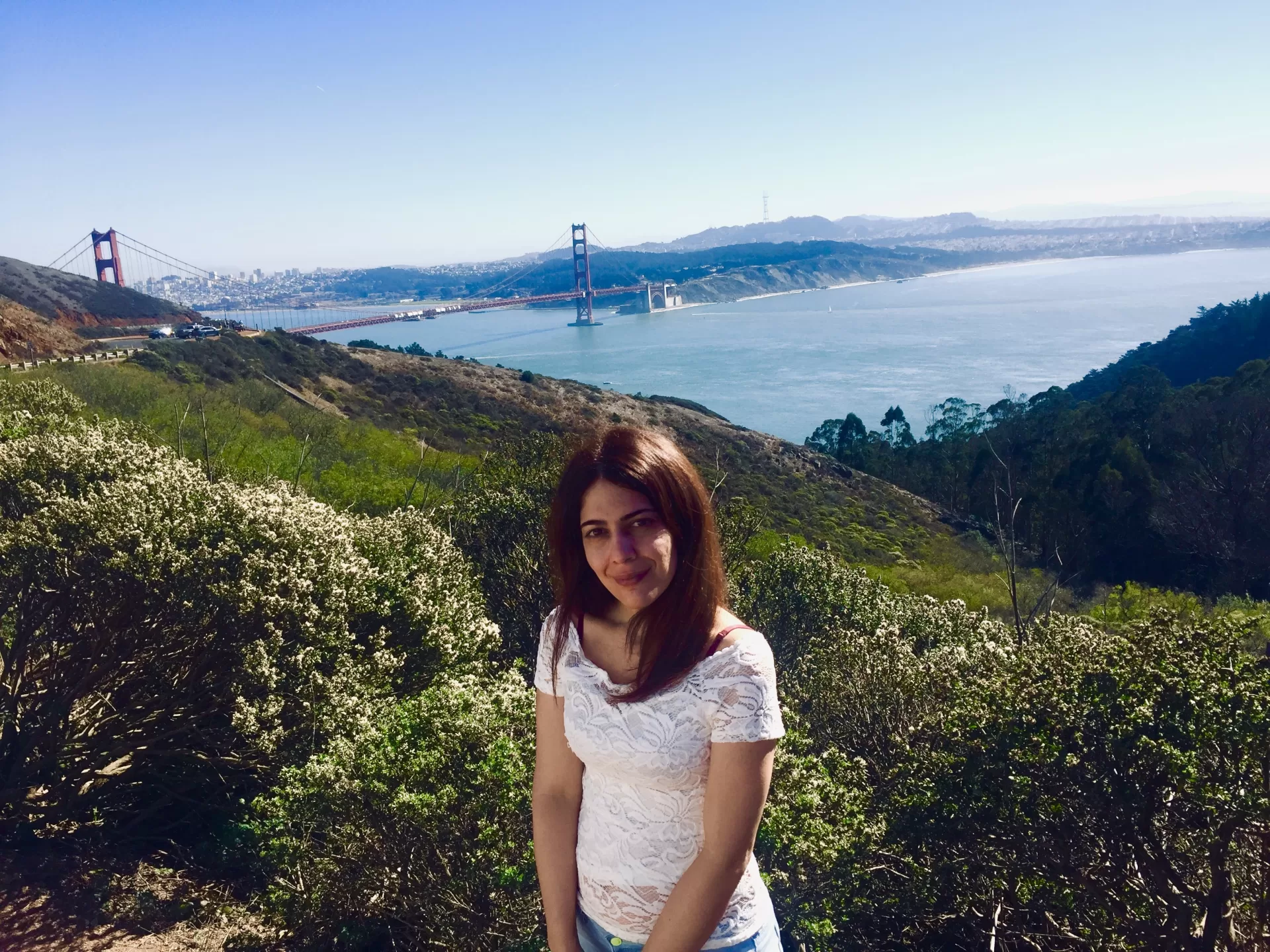
We left the U.S. just before I turned 11, so I never had a chance to appreciate the city truly. I returned to the Bay Area for a short stay at 18, during which I visited San Francisco. I remember driving by the Presidio and walking along Fisherman’s Wharf. While gazing out at the vastness of the Pacific Ocean from the Golden Gate Bridge by sunset, I felt a real sense of belonging to a city I had never lived in or spent much time in, yet it felt like part of me.
The same sentiment encompassed me this time around. Observing a mother and her toddler playing on the sand at the Wharf evoked memories of my mom and me decades ago, at the same location. Sometimes I wonder how my life would have turned out if we’d never left, what kind of person I’d be today.
While admiring the city’s panoramic views on a walk through Alamo Square Park, I catch sight of one of San Francisco’s most photographed sights, the Painted Ladies. I am immediately reminded of the sitcom Full House, which I used to watch growing up, whose opening credits feature the Tanner family having a picnic in front of the row of pastel-colored houses.
I could not come all the way to San Francisco without visiting Little Italy! Tricolor flags wave from rows of lampposts as I step into the North Beach district. My first stop is Caffe Trieste, at the corner of Grant Ave. and Vallejo St. I order a round of cappuccinos for my two friends and me and gaze at the interior, with its black-and-white photos on the walls and wooden furniture that once seated the likes of Francis Ford Coppola. I ponder on what may have drawn him to the coffeehouse to write the screenplay for The Godfather here, though the old-world Italian ambiance and the aroma of what was called “some of the best coffees in the city” could have played a role.
Rivaling the aroma of Caffe Trieste’s espresso are the whiffs of tomato, rosemary, and onion from Liguria Bakery. A family-owned operation famous for its focaccia, Liguria was founded in 1911 by Ambrogio Soracco, who immigrated to San Francisco from Genoa. The third generation of the Soracco family still runs the bakery. Although it closes at 2 pm, is open only Tuesday through Saturday, and sells only focaccia, it remains one of the area’s oldest operations and a Little Italy landmark.
A Little Italy that, like its counterpart in New York City, has shrunk over the years due to suburbanization, gentrification, and a decline in emigration from Italy.
As immigration from the Middle East to the Western Hemisphere has increased, many have had to learn the languages of their adopted countries. While in Iran, I was inspired to learn Italian, not so much because of plans to immigrate as wanting to speak a third language. I now find myself in San Francisco’s Little Italy, having left the U.S. for the Middle East, traveled to Europe, and become a global nomad.
I ponder my identity and my place in the passage of time, asking how my voice reshapes the significance of the past. To what extent do the stories and voices of those who came before me inform and influence my present?
“I know that you cannot live on hope alone…but without it, life is not worth living.”
For those of us with ties to the Middle East, clinging to hope in the face of conflict and adversity is our survival strategy. One that motivates us to respond to calls to action.
My hope is for a revival of the flower power movement. In the face of rampant capitalism, the military-industrial complex, and an individualistic culture, the collective passion of the 1960s needs to set the world on fire again.
Only time will tell if I’ll have the chance to visit my birthplace again. But I know it will always be a part of me; the City by the Bay, the beacon of hope that Harvey Milk embodied. A hope that still endures.